


Friday, September 28, 2007
Fix-Ups
A genius essay by Michael Swanwick that originally appeared in an issue of The New York Review of Science Fiction, on the subject of fix-ups, cannibalizations, mosaics, and chimeras. As someone who has written several works that could be categorized as one or another of these, I found it of particular interest. Here, There & Everywhere was written as a novel that could be broken up and sold as individual stories, and even though none of the stories actually sold it was referred to in a few reviews as a fix-up. All of the Celestial Empire stories that have appeared to date, conversely, are chapters of Fire Star, a novel which is as yet homeless, but as of last week every chapter of the book has been broken up and sold off as a short story. I'm certain that when the novel is eventually published it will be universally regarded as a "fix-up."
Go read the essay. Some terrifically interesting stuff in there.


MonkeyBrain Two-for-One Sale ending soon
Free Fiction Friday: "Penumbra"
Judex appears and disappears like a ghost, and would appear to have mild hypnotic powers. Indeed, he is first nicknamed... The Mysterious Shadow! He is a master of disguise, and an excellent fighter. He commands the loyalty of an organization composed of circus folks and redeemed apaches. Finally, he flies a plane and has a secret lair, where he interrogates his prisoners through a "television" screen -- everything Judex writes on the screen on his desk appears on a similar screen on the wall of his victim's cell.The serial was created by Louis Feuillade, who was also responsible for the popular serial Les Vampires, which gave the world the first modern femme fatale, Irma Vep. The image of Vep in a batwinged catsuit is an indelible one, and was a notable inspiration on later characters of the same type.
Just what all of these influences and intersections suggest is where the following story comes in.
by Chris Roberson
The morning papers all carried the story on their front pages, most with huge banner headlines above the fold. Perhaps the various editors thought their readers needed a diversion from another day’s litany about the numbers of young French servicemen dead in a recent military action, or about ground lost to or won back from the Boche. Or perhaps they knew that glamorous crime, particularly so close to home, would always sell newspapers. Either way, over breakfast all of
Ironically, of all of the reporters covering the event, Philippe Guerande of Le Mondial was the one most skeptical of the proposed connection to the infamous gang, the Vampires. Guerande had been writing about the suspected activities of the Vampires since the spring, even if his reports were buried in the back pages of the metropolitan section before the decapitation of Inspector Dural made front page headlines. The editors at Le Mondial, though, knowing full well how many copies a Vampires-related lead story could sell, had commissioned one of their staff artists to do a somewhat hasty sketch of the figure clad in skin-tight black slinking away across the rooftop, along side an inset photo of the victim’s body lying on the pavement, the crushed remains tastefully covered in a white sheet the instant before the photographer had taken the shot. Through the black-and-white grain of the photo, faint shadows could be seen appearing on the impromptu shroud, where the blood pooled on the body had begun to seep through the fabric. The editors then placed above the photo and pen-and-ink sketch a headline reading, “VAMPIRES THROW VICTIM FROM HIGH WINDOW – FLEE SCENE.”
Guerande’s article, however, left open the question of whether the infamous gang was or was not truly involved, stating merely that a man had fallen to his death from a high story window of a residential building, and that a figure clad in skin-tight black from head to toe had been seen fleeing the scene of the crime, running across the rooftops.
###
At the home offices of the banker Favraux, the topic was mentioned in passing, dispassionately, as one might discuss the weather or the quality of one’s dinner of the previous night. Not too miles away, war raged, and young men bled out their last strung up on wires in No Man’s Land, or huddled for shelter in trenches and hastily-dug foxholes, dreading the whiff of gas that might come drifting across the lines—chlorine, phosgene, or worse yet, mustard gas—but within the cool confines of Favraux’s wood-paneled study, all was peaceful and serene. Favraux and his guest had business to discuss, and the concerns of the wider world dwindled in comparison.
Favraux’s personal secretary, Vallieres, an older man with snow-white beard and hair neatly trimmed, was on hand as he always was on these occasions; but he kept to the shadows at the corner of the room, silent, unobtrusive, never noticed unless and until he was needed. Vallieres was the most trusted of all Favraux’s servants and employees, and the only one to whom the banker entrusted his most guarded secrets. Favraux never kept notes during his meetings, or a personal diary. Instead, he looked to Vallieres to monitor what was discussed, and to recall specific details on demand. So it was with great care that Vallieres followed the conversation between Favraux and his young guest.
Dr. Wayne, a young American in
Favraux’s distress was obvious and genuine, then, when Mrs. Wayne arrived in tears and without the gem in her possession.
“Oh, darling,” she said, throwing herself into her husband’s arms. “You simply must forgive me. I…I no longer have the Gotham Girasol.”
Dr. Wayne stiffened, and cast an uncomfortable glance to his host before turning his wife’s face upwards and looking her in the eyes.
“Martha,” he said, trying to sound calm but his voice audibly strained, “whatever do you mean?” His French was as good as hers, which is to say passable, but pronounced with a thick-tongued American accent that fell hard on Gallic ears.
“It was stolen from me nearly a week ago,” Mrs. Wayne answered, her voice quavering. “I was wearing it when we attended that ball on
Dr. Wayne held onto his wife for a moment, as his gaze drifted and settled on the middle distance, thoughts racing behind his eyes. Then he released her, and slumped into a chair. Mrs. Wayne, sobbing vocally behind a handkerchief, kept stealing glances at her husband, almost as though gauging his reactions.
The
Several days earlier, the Baron de Mortesalgues had held a grand ball at his home on
After a long moment, Dr. Wayne composed himself, and rose from the chair, straightening his waistcoat.
“Mr. Favraux, you must accept my apologies,” he said, turning to his host. “It appears that I will not be able to provide you collateral, after all, and as a result my wife and I might be forced to cut short our stay in
Favraux bristled visibly. Vallieres knew his employer’s moods and tempers well, and could see that the banker was pained at the thought of not laying hands on the precious gem, to say nothing of the interest he’d planned to collect on the loan. However, if Dr. Wayne were to return to the States without first investigating in the banker’s funds, Favraux stood to lose a great deal more. Just a few days’ grace, and the cashier’s check would arrive in
“Well, my dear Dr. Wayne,” Favraux answered, visibly pained by what he was about to say, “we cannot allow the criminal element and the capricious whims of fate to interfere with the business of men, now can we? Absent the security of the gem as collateral”—he paused, his face flushing red with suppressed anger and anxiety—“I am still willing to loan you a small sum, sufficient to allow you to stay on in Paris until our business is concluded.”
Dr. Wayne took Favraux’s hand, visibly relieved.
“I cannot thank you enough for your generosity, Favraux,” he said. “It would have been most… unfortunate, if our long negotiations would have been for naught.”
The hard glance Dr. Wayne gave his wife made it clear to Vallieres for whom such an outcome would have been the most unfortunate.
Once the arrangements for the loan were completed, and polite words were exchanged all around, Dr. Wayne and his wife took their leave.
When they had gone, Favraux dismissed Vallieres for the rest of the day. The banker’s daughter Jacqueline had convinced him that his grandson needed more masculine attention, since her own husband had died nearly three years before. As a result, Favraux had reluctantly agreed to take his daughter and grandson to the circus for the afternoon, though it was obvious that he regretted the decision.
Vallieres, unaccustomed to being at his liberty so early in a working day, saw nothing for it but to go home. Pausing only to pick up a copy each of the day’s papers from the newsagent on the corner, he returned to the apartments he kept in another quarter of the city.
Once safely in his study, Vallieres dropped the newspapers on his cluttered desk, piled high with papers, notes, and photographs. He laid his coat carefully across the back of a chair, and crossed the floor to an armoire with a full-length mirror set in its door.
With practiced motions, Vallieres removed his snow-white beard and mustaches, and pulled off his wig of snow-white hair. Dropping them into a bowl on a side table, he stood straighter, an intense scowl on his young, lean face. He smoothed back his short black hair, and regarded himself momentarily in the mirror. Having put aside the mask of the ever-loyal, always patient Vallieres, he stood revealed for who he truly was: Judex!
###
Of course, Judex himself was something of a mask. Not the name with which he was born, he chose it by necessity, to help him fulfill the oath he made to his mother, so many years before. An oath to avenge the death of his father, the Count de Tremeuse, who took his own life after losing the family fortune to bad investments. Investments made on the advice of an eager young banker, Favraux.
That his father died just as news arrived that a gold claim he had in
Instead, fate had decreed that Judex would own a gold mine, along with his brother, who was currently in
And at the moment, Favraux’s dealings included the young American couple, the Waynes.
Judex sat at his desk, and looked over the piles of newspaper clippings, bank records, notes, photographs, medical documents, receipts and vouchers. Ephemera and trivia, bits of information discarded in the wake of the young doctor and his wife. A portrait of a life painted in tiny bits of data, like the points in a Seurat painting.
Judex had been investing Dr. Wayne and his wife as a matter of course, these past weeks. If the
Before that morning, Judex had found no reason to suspect their sincerity, nor to believe they were anyone but who they said they were. He had initially suspected that the couple might not be the
Why, then, did Judex feel so strongly that something was amiss? Mrs. Wayne’s recounting of the theft of the Girasol this morning, though emotional, was not convincing. It had too much the air of a rehearsed speech, of a dramatic address delivered on queue. She was lying, but about what?
The answer, Judex found, was right in front of him.
Amongst the piles of research materials on the
Judex drew a jeweler’s loop from the desk draw, and peered at the photo through its magnifying lens. Around the neck of Mrs. Wayne he could make out the Gotham Girasol, suspended from a silver chain.
Judex laid beside that photo another, clipped from the society pages of the Paris Chronicle just a few days before. It was of Mrs. and Dr. Wayne, taken the evening of Baron de Mortesalgues’ ball on
He sat back, his brow creased. There could be no doubt. In the photo, Mrs. Wayne was clearly not wearing the Gotham Girasol. The gem had not been stolen that night at
Why was Mrs. Wayne lying?
Perhaps the
Judex was convinced the Vampires were involved in some fashion. There were simply too many points of congruence to dismiss them as coincidence—the Waynes in attendance at the ballet when Koutiloff is poisoned, and again at the Maillot Avenue ball for the most daring robbery of the decade. What other connections might there be?
Judex was committed. He would investigate the Vampires in parallel with his ongoing researches into the
###
Judex was not the only one investigating the Vampires. The police were involved, naturally, their every available resource assigned the task of searching for the gang. Impatient at the progress of the investigation to date, though, the authorities had called in the assistance of private detectives like Celeritas Ribuadet and the famous Rouletabille, and citizens such as Cigale Mystère—a civilian adventurer who assisted the Parisian authorities from time to time, cruising the streets in his electric car, loaded down with futuristic gadgets and devices—and the Nyctalope—who prowled the nights for sign of the Vampires, his keen eyes seeing what others could. But so far no one had been able to track the Vampires to their lair, nor divine the mystery of who led the mysterious organization. There were whispers of a Grand Vampire who directed his subordinates movements from behind closed doors, and perhaps even higher echelons of power above even that, but they remained only whispers, nothing more.
But the police and the other mystery men could busy themselves tracking down the criminals. Judex was interested in matters only as they pertained to Favraux. What deviltry the Vampires did in the larger world was of no concern to him. Until his father had been avenged, there could be no justice.
###
It seemed to Judex prudent to being his investigations into the Vampires at the site of their most recent crime. Their earlier exploits—the decapitation of Inspector Dural, the poisoning of Marfa Koutiloff, the mass robbery and possible kidnapping at the home of the Baron de Mortesalgues—he knew well enough from the detailed coverage provided each in the daily news. If there were hidden connections to the
It took only a few hours investigation and a few francs placed in the right palms to turn up a number of interesting facts about the case. The victim, who had fallen to his death from a fifth story window, was one Jean Morlet, an associate the Monsieur Oreno who resided at that address. However, Judex could find no record of this Oreno before the previous week. In addition, he was able to discover that Oreno had rented out the entire fifth floor of the building the day after the events at the
The next day, once “Vallieres” had completed his duties for the banker Favraux, Judex made for the jail, sure he was feeling around the edges of some larger puzzle. It took only a few francs to learn the prisoner’s name, and a few francs more to convince the gendarme on duty that Judex should be allowed a brief counsel with him in private.
“I’ve already told the other police everything I’m going to say,” the prisoner said, after Judex had been ushered into his cell. The gendarme locked the door.
“Just call when you are ready to go, monsieur,” the gendarme said, retreating down the hall.
Judex waited until the jailer was well out of earshot, and turned his attention to the American. He was young, just entering his twenties, with high, narrow cheekbones, a prominent hawk-nose, and piercing eyes.
“I am not with the police, Allard,” Judex said, drawing his cape tight around him, gazing at the American from beneath the brim of his hat. “I have questions of my own.”
The American seemed to squirm beneath Judex’s steady gaze.
“Alright, then,” he finally said, his eyes shifting to the ground. “What is it you want to know? It’s not as if I’ve got anywhere else to be at the moment.”
“You were arrested for attempting to burgle the residence of a Monsieur Oreno, which I will come to in a moment. But first, I’m curious to know why you are in Paris, Mr. Allard. Why come to a land in the grips of war, when you could easily live in safety at home?”
Judex could not help but think of Raphael Norton and his embezzled fortune. But if this were he, what had become of his female accomplice, Miss Florid?
“Look,” Allard said, raising his chin defiantly, “I’m not about to sit out the war like those cowards back at home in the States, too fat and lazy to come to the defense of their European cousins. If all men don’t act to stamp out evil at its root, it’ll spread like a weed all across the globe. And then where will we be?”
Judex’s mouth drew into a tight line, and he said, “I’m sure I don’t know.”
“Well, I couldn’t sit idly by while others fought for the cause of justice,” Allard went on. “I’m a… how do you say it in French?” He paused, and then said the English term, “barnstormer.”
Judex nodded slowly, and translated into the French, “An aviator.”
“Yes,” Allard answered, “I’m an aviator. Anyway, I have relatives in
“If you already suspect that this Kentov will never contact you here, why remain in
Allard’s gaze shifted, and a blush raised on his cheek.
“I have been… distracted,” he finally said, a faraway sound to his voice.
Judex pulled his cape tighter, but nodded slightly.
“Very well,” he said. “Now we come to the matter of Monsieur Oreno. Who is he to you?”
“He’s a cheating bastard, and a liar!” Allard scowled, teeth clenched, his eyes flashing. “Oreno stole something of considerable value from me, and I was just trying to get it back.”
“How did you know him?”
“I’ve been going to a cabaret called La Veuve Joyeuse a great deal these past few weeks,” Allard said, a wistful tone creeping into his voice, “and I met Oreno there one night. We talked a bit about the art of mesmerism, which he claimed to have some special knowledge of. I don’t have any proof of this, but I think that he might have clouded my mind in some way. How else could he have known about the…” He paused, and bit down on the next word he’d been about to say. “About the item, that is,” he finished, lamely.
“What was it that he stole from you?”
Allard expression was guarded, his lips drawn tight.
“Something very dear to me,” was all he would say.
###
A few nights later, after fruitless investigations, Judex returned to his apartments late in the evening. He looked forward to the day when his brother returned to
Judex’s rooms were darkened, but he knew in an instant that something was amiss. A subtle scent on the air, a tingling sensation on the back of his neck. Once the door was shut and locked behind him, he knew. He was not alone.
“Do not turn on the light,” came a soft, sultry voice from the darkness. “Or, if you must, turn on only the table lamp. It is so much nicer that way, don’t you think?”
Judex’s fingers ached for the brace of pistols he kept in the armoire, a dozen steps across the room. He would never go out unarmed again. In a flash, he calculated the path and distance to the armoire, the seconds needed to reach it and open the door, grab and aim the pistol—if the intruder were armed, he’d never reach it in time.
“If you’re thinking of these,” the voice from the darkness said, followed by the distinctive sound of a pistol’s hammer being pulled back, “I liberated them from the cupboard when I came in. I do hope you don’t mind.”
Judex stood in place, but reached down to the table at his knees at switched on the lamp.
Seated in his chair, with her feet up on the desk, was a woman wearing a skin-tight black jumpsuit. She was covered head to toe, with only her face left revealed. Her smoldering, fierce gaze caught Judex’s, and she smiled.
“A pleasure to make your acquaintance, Judex,” the woman said, gesturing him towards the couch with the barrel of the pistol, the other held casually in her lap.
“Who are you?” Judex stood his ground, arms crossed.
“Who I am is not of particular importance at this juncture, but whom I represent most definitely is.”
“The Vampires,” Judex hissed through his teeth.
“Got it in one.” The woman smiled. “I have come to tell you something. This murder that you’ve begun investigating, the man who fell to his death from that building—the Vampires had nothing to do with it. Our leader has only recently become aware of your existence, and has ordered that you be left alone for the moment because he is not yet sure whether you can be of use to us in future. If you interfere in our affairs, though, and go from being a potential asset to being a nuisance, we will be forced to eliminate you.”
“And to forestall this you deny one of your crimes? How do you benefit?”
The woman bristled, a cloud passing momentarily across her smooth features.
“We deny none of our actions!” The woman gestured with the pistol, and Judex tensed involuntarily, anticipating a shot. “Did we cut the head from that oaf Dural? Yes! Did we poison that bitch Koutiloff? Yes! But did we throw this Morlet to his death last night? Most definitely not.”
“Why should I believe you?” Judex’s eyes narrowed.
“Because if we were truly guilty of the killing, we wouldn’t be warning you away. We’d just kill you for interfering in our business. But I prefer to kill those who deserve to die.” Her mouth drew into a line, and she added in a hushed whisper, “Like that bastard
“And what about the
The woman jumped to her feet, tossing one of the pistols to the ground with a thud, and pointing the other square at Judex’s chest.
“You mention
When she reached the window, her attention briefly turned away from him, Judex prepared to rush forward, intending to tackle her to the ground. As though she could sense his intentions, though, the woman spun around, and pointed the barrel of the pistol directly at Judex’s face.
“Please don’t try that,” the woman said, sounding again all sweetness and light. “I don’t want to have to hurt you unnecessarily, and it would be a shame to mar such a striking profile.”
With that, the woman tossed the pistol to the ground, and stepped over the sill to the ledge beyond. When Judex rushed to the window to look out, she had already disappeared into the night.
###
Judex could not sleep that night. The information the woman provided, however unintentionally, was the last puzzle piece that he needed. He had only to confirm his suspicions, and all would be clear.
Returning to the night air, his cape wrapped around him and his hat pulled down low over his brown, Judex made his way to the scene of the crime. With ease, he did what Allard and the black-suited burglar had both failed to do, breaking into the home of Monsieur Oreno without once being seen. Oreno was not in, no doubt meeting with his associates at La Veuve Joyeuse cabaret at that hour. Crime does not keep workman’s hours, after all.
In a locked bedroom in Oreno’s suite, Judex found what he was looking for, and more besides, packed into several valises and a few small chests. It was the work of just a few minutes to transfer the contents of the cases and chests to his automobile, parked on the street outside. One item in particular he slipped into his pocket.
Driving to the Public Assistance Bureau to make a donation, Judex cursed himself for his earlier blindness. Monsieur Oreno. “M. Oreno.” He should have seen it long before.
###
Mrs. Wayne was packing up her belongings in their rooms at the Park Hotel. Her husband had concluded his business with Favraux that afternoon, and they would now be returning home to
“Your pardon,” said a voice from the shadows, and Mrs. Wayne leapt a few inches into the air, her heart in her throat.
“I mean you no harm,” the voice continued, and Judex stepped out from a darkened corner, silent as a ghost.
“W-who are you?” Mrs. Wayne clutched a black leotard to her chest, wringing the fabric in her hands, her packing forgotten.
“You can call me Judex.”
“Did you say… justice?”
Something like a smile played across Judex’s mouth.
“No. Judex. But it is about justice that I’ve come. I know what you have done, Mrs. Wayne.”
Judex pointed to the black leotard in her hands, with scalloped-edge bat wings attached at the shoulders and wrists.
“I see that you even kept the costume you wore that night.”
Tears began to stream down her cheeks.
“I hadn’t meant for anyone to get hurt, honestly. But that man chased me out onto the ledge, and then he fell, and then… But I just had to.. I had to get it back…”
Judex held out his hand and opened his palm, revealing a fire-opal with a faint purple cast and lights dancing deep within. The
“I broke into Oreno’s rooms,” Judex explained, “and found what remained of the loot from the
Mrs. Wayne looked with wide at the gem in Judex’s palm, and then met his eyes.
“You mean…?”
“Yes, Mrs. Wayne, I know that you gave away the Gotham Girasol some time before the night of the ball.”
Mrs. Wayne struggled to take a breath.
“What will you…” She paused, swallowing hard. “That is, what will you do with…”
“I have given the pilfered goods to the Public Assistance Bureau, where they will no doubt serve society better than they ever could have done in the hands of their rightful owners. I am, however, prepared to return the Girasol to you.”
“No,” she said, turning her eyes away. “I could not bear to hold it. There is another who should have it, who should always keep…” Her words choked off in a stifled sob.
“Allard,” Judex said simply.
Mrs. Wayne was shocked, but she nodded, slowly.
“You met him at a cabaret, unless I miss my guess,” Judex went on, “and you found him a welcome change to your somewhat brusque and acerbic husband, the good doctor. You wanted to give him a token of your affection, one which you prized above all others. Otherwise, the gesture would be meaningless, no?”
Mrs. Wayne nodded still, as though hypnotized.
“No,” she said, then shook her head, as if to clear away cobwebs. “I mean, yes. I mean…” She drew a deep breath, collecting herself. “I met… him… a few weeks ago. My husband had been so busy with his meetings that it was almost as if we weren’t going to have a honeymoon at all. I started going out on my own, to the restaurants and cabarets. It was at La Veuve Joyeuse that I met… Mr. Allard. So intense, and an aviator. How dashing he was. I suppose you could say that we fell in love. She gave him the gem in a moment of passion, symbol of my feelings for him. But I’d soon have reason to regret it.”
Mrs. Wayne glanced at the gem, still resting in Judex’s palm.
“The next day, my husband told me that we might need the gem for collateral. I knew that any day he might come and ask me for it, and I wouldn’t have it. As soon as I could I rushed to see Mr. Allard, to get it back, but he told me that it had been stolen by this Oreno character. He promised he’d get it back from Oreno, but the next thing I knew Mr. Allard had been arrested.”
“So you had no choice but to steal it yourself,” Judex said.
“Yes. I’d heard all the stories about the infamous gang, the Vampires. I hired a costume from the Costumier Pugenc, the same I’d seen in the ballet weeks ago, with the idea that if anyone saw me breaking into Oreno’s apartments, the blame would be cast on the Vampires gang. The man came upon me just as I was entering the room, though, and then he fell to his death. After that, I knew I’d never have another chance at stealing it back, so I told my husband it had been stolen that night in
Mrs. Wayne took a deep breath and sighed. She smoothed the fabric of the black leotard in her hands, and then set it gently back on the bed.
“I suppose you will turn me over to the police now,” she said, sounding resigned. “I am wanted be the law, after all.”
“I wouldn’t give a bent sou for the law,” Judex said, tightening his hand into a fist around the gem. “The law turns a blind eye while villains prosper, allowing a cancer to eat away at society’s heart. No, I care nothing for the law. I care only for justice.”
Mrs. Wayne shook her head, looking like she wanted to spit.
“Justice? Do you want to know about justice, Monsieur Judex? Then I will tell you. I have just learned today that I am with child. Pregnant. And I don’t know whether my husband or my beloved is the father.”
“You talk to me of justice? What are your sordid affairs to me or to Lady Justice?”
Mrs. Wayne lifted her chin, defiant.
“Because even if the law never lays a hand on me, I still pay the price for my deeds. My own life is ended here, for the sake of my unborn child. Were it otherwise, I would leave my husband, and my beloved and I would be together forever. But what kind of life would my child have, with a penniless aviator as a father. Always at the fringes of society, living forever in the shadows. No, better to return home with my husband, letting him think the child is his, so that my baby can grow up in comfort, with all the opportunity in the world. So what if my heart belongs to another, and I die inside a little every moment we are apart? I live now for the sake of my child.”
Judex stood silent, appraising her, and found he had nothing to say. Justice, the only god Judex worshiped, indeed moved in mysterious ways.
Tucking the gem back into his pocket, Judex strode to the door, making to leave. He drew his cape around him, already seeming to blend into the shadows.
“Wait!” Mrs. Wayne said, stepping forward, raising a tremulous hand. “Will you see…” Her breath caught in her chest, and she swallowed hard before continuing. “Will you see Mr. Allard again?”
Judex shrugged beneath his cape.
“I do not know, madam.”
“If you should see him, could you give him the Girasol for me? As a keepsake to remember me by?”
Judex expression remained hard, but he nodded. He turned to the door.
“Only,” Mrs. Wayne said, taking another step forward, “please don’t tell him about the child. He has his own life to lead, and doesn’t need a shadow hanging over him.”
Judex did not turn around, but nodded again.
“I will,” he said softly, and then disappeared into the night, leaving Mrs. Wayne alone with her memories.
###
The next day, an anonymous party posted bail for the American aviator, and Allard was released on his own recognizance. When his possessions were returned to him, Allard was surprised to find among them an envelope containing a near-priceless fire-opal and a railway ticket. The train left
That same afternoon, Dr. Wayne and his wife were already in
In the home offices of the banker Favraux, Judex hid behind the mask of Vallieres, waiting for his moment to strike.
And in the streets of
Copyright © 2005 Monkeybrain, Inc.
Labels: freefiction
Thursday, September 27, 2007
Spoon's "The Underdog"
Now, clearly it's not, and heard on something with a bit more fidelity than the low-end speakers buzzing in my 1997 Ford Escort it's pretty much immediately obvious. But still, there does seem to be an influence here, doesn't there? Something along these lines?
Wednesday, September 26, 2007
It Came From Tokyo

Tuesday, September 25, 2007
Zot!
Acclaimed comics artist and theoretician Scott McCloud will see his classic comics series, Zot!, republished by HarperCollins as an original trade paperback edition in July 2008. One of McCloud’s earliest extended works of fiction, Zot! is a seminal work that reflects the influence of both manga and the emerging alternative comics scene on McCloud’s comics. The book was also instrumental to the creation of Understanding Comics, his groundbreaking theoretical work on the comics medium. The HC book deal was negotiated by the Judith Hansen Literary Agency.I read all of Zot! in individual issues, and have been waiting for the series to be collected for years. Each time someone starts publishing trades, though, they either go out of business or drop the series before getting to "Earth Stories," the last of them, where the real heart of the book is. Getting them all in one edition at least means that won't be happening again.
Hope Innelli, associate publisher of Harper Paperbacks, said the new 576-page edition of Zot! will collect the entire series in one volume. While early issues of the series, which was originally published by Eclipse Comics, ran in color, the new edition will be completely black & white. “That’s a creative decision by Scott,” said Innelli, explaining that McCloud believes the series really came together when he focused on working in black and white.
The new edition will have a trim size of 6”x9” with French flaps and will be priced at $22.95. The book will include extensive commentary by McCloud on its creation, as well as much never-before-seen material. The book will also include “the Earth Stories,’ the last nine stories in the series, which have never been reprinted. “Zot! is the origin of Scott’s comics,” said Innelli. “It’s where he defined his style. We’re so used to Scott explaining comics, but now we get a chance to experience his comics.”
Highly recommended stuff. Check it out when it hits shelves, and I think you'll agree.
New Review
An updated version of a previously published chapbook, Set the Seas on Fire is a virtuoso performance that combines the sea-faring story with fantasy set in the Napoleonic era. Roberson quickly sets the scenes with two intertwining stories.
First we are introduced to the young Hieronymous Bonventure, who is ostensibly being taught how to fence – but in the developing acquaintanceship with his tutor, he learns the deeper reasons for his tuition. The main narrative is set in 1808, with the HMS Fortitude (on which Bonaventure is Lieutenant) in desperate need of repair after a skirmish with a Spanish galleon. Coming across survivors from the galleon, they hear of an island of terror where the ship is beached. Once ashore, the crew meet the inhabitants, and embark on individual adventures – with Bonaventure getting more out of falling in love than he could ever hope for – before finally descending into Hell.
Roberson combines a sense of period with the strong sense of wonder and fear. Whilst the setting is Napoleonic, the reader is never left with a sense that the period is a backdrop. It oozes onto the page, not just in the warfare and hierarchy, but in the mannerisms and etiquette. At one level he harks back to the ‘Fantasy of Manners’ school – but at another, the action takes hold and really makes the story special.
Untypically for fantasy, his characters encounter the Other and are overwhelmed by it. The sheer alienness of Pacific native culture to Western minds (long the preoccupation of anthropology) is developed so well that, ultimately, it is both familiar and different. Roberson does not try to understand the stories, but he uses them brilliantly to demonstrate the strengths and shortcomings of the main protagonists.
Set the Seas on Fire is a thoughtful but rip-roaring adventure, combining Hornblower and Lovecraft with a subtlety certainly not seen in the ‘New Weird’ or other naval stories. The other writing of Roberson’s that I have read has left me astounded at his control of silences and muted responses amidst terrifying situations, and Set the Seas on Fire is certainly in that class. I cannot recommend this book too highly as an intelligent, readable novel.
Labels: reviews
Monday, September 24, 2007
Book Report
I also read the first part of David Drake's Redliners, which I'm enjoying, and the first hundred or so pages of George R.R. Martin's A Game of Thrones, which is fan-fucking-tastic. But reports on those will have to wait until I finish them, since this is modeled after pass-or-fail school reports intended only to prove I've completed reading.
In that case, I'll dip a bit back into the things I read a bit earlier in the year, and see what I have to recommend.

D.M. Cornish's Monster Blood Tattoo: Book One: Foundling.
I read this a few months back, and liked it quite a bit. This is one of those books marketed as Young Adult, that could be as easily enjoyed by Middle Readers as by adults. I picked it up on the strength of the appendices, which run 121 pages long (more than a quarter of the book) and include a glossary that puts some dictionaries to shame, illustrations of the clothing typical to different professions, a calendrical system, profiles on different types of sea-going vessels, and insanely detailed topographical maps. Seeing that, I didn't much care what the story was actually about, I just wanted to see if the author had actually managed to make use of all of it.
To my surprise, the story is actually about quite a bit. This is an adventure story in the grandest traditional sense, about a young foundling who leaves the orphanage where he was raised (to be particular, Madam Opera's Estimable Marine Society for Foundling Boys and Girls) to take a position as a Lamplighter, one of those who patrol the highways of the Empire, keeping monsters at bay. He gets sidetracked by misadventure, falls in with pirates, escapes, and ends up in the company of a fulgar, a monster-hunter whose body has been surgically altered by the addition of new organs that allow her to store huge amounts of electricity for long periods of time, which she can project as an offensive weapon through her tall metal staff of office. Of course, the surgical procedure that grants the monster-fighter her power means that her body is constantly in rebellion against itself, and has to keep taking regular doses of a medicinal substance to keep her own body from rejecting the new organs and killing her.
This is a fantasy story, but it's an odd kind of fantasy. There are monsters, but beyond that there is little that one might call "magic," with everything else having a pseudo-scientific basis (or at least a pseudo-natural philosophical basis). And it's a narrative not afraid to slow down and take it's time. That said, even though this is book one of an ongoing series, presumably, it never felt plodding or padded.
My only criticism, if I have one, is that the cover doesn't really "sell" the concept. I understand that this was illustrated and designed by the author (who also did all the interior illustrations), and I can understand his intentions, but I'm not sure the book is best served by it. Come to that, the title itself, while it comes to take on significance in the reading, is not necessarily evocative on first blush. My criticisms are short-lived, though, because I see that the new softcover edition has a new cover design that handily addresses both concerns.

See, isn't that nicer?
A nicely written start to a promising series, and recommended for anyone interested in impressive world-building or good-old adventure.
Labels: bookreport
New Blog Review
"The Voyage of Night Shining White" is stronger emotionally than Baker’s story, and does not have the logical flaws of Reed’s (although, not being a scientist, I might easily have missed such flaws). Its ending is strong and fitting, and the twin philosophies of Confucianism and Daoism serve the story well. This is the second story in Roberson’s Celestial Empire series that I have read, and I have liked them both a lot. I plan to seek out some of his novels in the series as well.
Labels: reviews
Pangaea Ultima

Something kinda like this, perhaps?

Weird, huh?
(I thought for sure I had credited Scotese as an inspiration in the author's notes in Paragaea, since his maps were a considerable influence on the development of the post-historic world of Paragaea, but apparently I forgot to do so. In which case, I'll make poor amends by doing so now.)
Friday, September 21, 2007
Free Fiction Friday: "Secret Histories: Lord John Carmody, 1939"
(To my embarrassment I discovered last week that I'd inadvertently stolen the name of this feature from the good folks at Futurismic, who have been doing a whole Friday Free Fiction thing of their own. Go check out their splendid blog, won't you? And try to find forgiveness for this subliminal thief in your hearts...)
For more about the Carmodys, and about Lord Arthur in particular, stay tuned for the forthcoming End of the Century. For more about floating islands of doom, check out "Secret Histories: Professor Peter R. Bonaventure, 1885" (and maybe sneak a peak at the devil-bat sections of Set the Seas on Fire...).
Lord John Carmody, 1939
by Chris Roberson
New Year’s Day, and the public room at the
Dressed immaculately in a style a few years past fashionable, with dark hair worn long and brushing his high collar, the man in the far corner seemed more reflective than celebratory. The few staff members in attendance were hardly surprised. The Hythloday Club had never been what one might call boisterous, and Lord John was certainly among its more sober members. Still, a shadow seemed to lay across his brow, and the ancient scar along his right cheek stood out like a scarlet welt, as it did only in his darkest moods. He seemed troubled, but it wasn’t the place of the staff members to approach him. They held back, waiting to come when called, and worried where they themselves would be in another year’s time.
Lord John sat alone in his far corner, the only member of the Club in attendance. To the natives of his adopted home in the south African veldt, he was known as Nkosi, the Pride of Lions; to the Arab traders that crisscrossed the burning sands of the Sahara, he was known as Al Abbas; to the other members of the Club, and to a dwindling few peers back in fog-wrapped England, he was known as Lord John, the 11th Baron Carmody. But to his brother, he was known simply as…
“Jack!”
Lord John, roused from his dark thoughts, half rose from his chair, but his brother was on him before he had reached his feet, encircling him in strong arms and almost crushing the breath from his lungs.
“Hello, Rex,” he managed, returning the embrace.
Had it been any other two men, the staff members might have thought they were watching wrestlers grappling with one another, whipcord muscles standing out like steel bands beneath bunched cloth, both with grips sufficient to snap trees in half. But they had grown used to the sight over the previous years, and turned to their duties without remark.
The newcomer finally released his hold on Lord John, and gracefully slid into the chair opposite him.
“What are you drinking?” the newcomer asked.
“Brandy,” Lord John answered.
The newcomer signaled for a waiter, and ordered another round for the pair of them. The waiter hurried over with the tray, his eyes wide, and after setting the drinks on the table lingered on, his mouth half open.
“It’s a pleasure to meet you, ‘King’,” the waiter sputtered. “That is, Dr. Carmody. I read about you in the papers every week. I mean, the way you handled that fink the Scarlet Spectre …” The waiter mimed a few punches, shadow boxing. “That was really something, and I mean it.”
“Well,” the newcomer answered, smiling slightly, “you can’t believe everything you read.”
The Club’s major-domo, who’d been on the staff longer than anyone could remember, rushed over to the table, taking the waiter by the arm.
“I apologize, gentlemen,” he began, his tone obsequious. “Reggie here is new, and I’m afraid he hasn’t quite learned all of our rules just yet.”
The waiter looked from his boss, to the two men at the table, and back again, his face falling.
“Gee, Dr. Carmody,” he said, “I’m sorry. I didn’t mean anything by it….”
“No problem,” the newcomer answered. “No harm done.”
“Thank you, sir, thank you,” the waiter replied, nodding nonstop and carrying the tray back to the bar. The major-domo followed, his expression set.
When they were out of earshot, the newcomer turned to Lord John and smiled broadly.
“I never thought I’d see the day,” he said. “What do they think I am? Some kind of matinee idol?”
Lord John shook his head, chuckling softly, and regarded his brother. Though they’d had different mothers, John thought he could see something of their father in his brother’s slate gray eyes. Rex “King” Carmody, boxer, inventor and, if their waiter was to be believed, darling of the masses. Over a decade John’s junior, Rex had been trained to the peak of physical and mental perfection by their father, and for the last ten years had been making use of that legacy to wage a one man war on crime and injustice, both at home in
“Who can blame them,” Lord John answered. “With those devilish good looks of yours?”
“Watch it, Jungle Boy,” Rex replied, his fists held comically before him, “these are the hands that took down the Scarlet Spectre, remember?”
Lord John laughed, and took a long draw of his brandy.
“I’ll try not to forget,” he said. “Speaking of which, I have to add my compliments to those of our outspoken Reggie. I followed the news of that encounter as best I could in
“Aw,” Rex answered, shrugging, “he wasn’t that much trouble. Just had to have my men block the play of those Dark Overlords of his, and when it came down to just the two of us, it was a cakewalk.”
“Ah, yes,” Lord John said, “your men. ‘The Four Aces.’ Isn’t that what the papers are calling them now? Is Wainwright still with you?”
“Sure is. And I don’t know who hates that Aces name more, me or the boys. Thanks for sending Wainwright to me, by the way. I know I’ve said it before, but he’s been worth his weight in gold these last few years.”
“I knew he would be,” Lord John replied. “When his battalion accompanied me into the Lost City of Ôr, all those years ago, Wainwright was the only one on whom I found I could rely. When he was ‘retired,’ shall we say, by his superiors, I knew he could do much worse than to join your associates.”
“He doesn’t get bored, if that’s what you mean. Just a few weeks back we were down in
“Nazis,” Lord John spat, his face dark. “They seem to cover the planet like a pestilence, these last few years. The Baroness von Eiszeit, damn her eyes, just last month tried to lure me into another one of her plots, this time to use some Viking hoodoo to turn Africa into a frozen wasteland, with her as Snow Queen and me her simpering page boy.”
“I’m guessing you didn’t take her up on the offer.”
“Hardly.” Lord John took another long pull of his brandy. “What is it with these women? They all either want to eviscerate you, or lure you to their conjugal bed, or both.”
“Who knows?” Rex answered. “Maybe they just have a thing for guys raised by cats.”
“There’s that stellar wit I’ve grown to love this last decade,” Lord John answered, with hardly a trace of humor.
The two brothers had both been grown when first they met, some ten years before. Their relationship had begun as a tenuous one, at best, the bonds that drew and kept them together not really forming until after the death of their father, Arthur Carmody. The senior Carmody had been a member of the Hythloday Club while still living in England, and though he had let his dues lapse after the tragic events of his expedition to Africa, with the loss of his young wife and the apparent death of their infant son, the Club had recognized the legacy rights of his grown sons, and with little reluctance admitted them as members. That each of them was, in his own way, an explorer of the highest rank in his own right, could not but help their case.
In the years since, the two brothers met once a year at the Club, either the branch in
“I had a brief run-in with an old friend of yours this past year,” Lord John continued, after signaling for another pair of brandies. “The tall fellow with the eye patch and the pronounced limp, always on about the evils of modern society and the treacheries of men… What was his name?”
“Dr. Fox?” Rex asked.
“That’s the one.”
“Aw, ain’t he a peach?” Rex leaned back in his chair, folding his arms across his broad chest. “I had a scuffle with him myself since we met last. He’d managed to find that island of his again, and was threatening to bomb the Eastern Seaboard back into the stone age if he wasn’t named Emperor of America.”
“Oh, yes,” Lord John answered, smiling slightly, “I’d almost forgotten the island. What does he call it again?”
Rex grimaced.
“The Floating Island of Doom,” he replied, chagrined.
“Where do they come up with these names?”
“Beats me,” Rex answered. “It’s like they all go to the same tailor, and all play using the same goofy rule book.”
“And they all want to take over the world, in one way or another, of course.” Lord John paused for a moment, rubbing his chin. “But they never seem to have a very solid idea of what they’ll do once they actually do take over the world, do they? Just your standard, ‘Nations will bow before me’ rigamarole.”
Rex seemed lost in thought, the bottom of his brandy snifter occupying his attention.
“I don’t know,” he finally answered, distracted, “sometimes I don’t blame them.”
“Hmm?”
Rex looked up, not seeming for a brief instant to realize that he had spoken.
“I mean, taking over the world,” he continued. “I don’t know that I blame them. Come on, Jack, look around. We traipse all over the world, stop the Jaguar Men from taking over this banana republic, stop the Steel Dragon from using his death ray, and at the end of the day, what have we really accomplished?
“You said it yourself. These Nazis are every damned place, and me keeping them from unleashing some ancient Aztec demon or you keeping them from turning Africa into an ice skating rink doesn’t do a damn bit of good for those poor bastards in
Lord John regarded his brother in silence, his elbows resting on the table, his fingers steepled in front of his face.
“And your solution is to beat them to it by letting Dr. Fox take over the world?” he asked, bemused but with a darker undercurrent.
“No, Jack, of course not,” Rex thundered. “But why not somebody better, somebody like you or me? I don’t have any great desire to run the show, but I know I’d do a damned sight better job at it than the jokers we’ve got minding the store now.”
“I’m sure you would,” Lord John allowed, “but then what? Suppose you did use the technology and resources at your disposal to topple all existing governments, and set your self up as ruler supreme. Then suppose that you made some decision with which I didn’t agree…. Not me as some abstract, anonymous individual, but me. Your brother.”
“Half brother,” Rex corrected, but seemed to regret it immediately.
Lord John nodded, his brow furrowed and the scar along his cheek standing out bright against his tanned skin.
“Very well,” Lord John replied. “But tell me, what would you do? The problem with being an absolute dictator is that your dictatorship must be absolute. You couldn’t brook any dissent. You’d need to be prepared either to defend your rule against my challenge, acquiesce to my every demand, or have me imprisoned. Or you’d have to kill me.”
Lord John left off talking, and the two men sat staring at each other for long moments. Each supposed, despite himself, that his brother might be wondering which of them would prevail, if it came to a fight between them.
It was Rex who finally broke the tension, breaking into a smile and relaxing in his chair, slamming his broad palms down onto the table top.
“Dammit, Jack,” he laughed, “leave it to you to take all the fun out of ruling the world.”
Lord John returned his brother’s smile, and sipped his brandy.
“Sorry, old boy,” he answered. “Habits of a lifetime.” He paused for a moment, reflective. “Still, I can’t say that I blame you, these occasional thoughts of yours. Back in
Rex nodded, his eyes lowered.
“I have to admit,” he finally said, in a low voice, “that there are times when a father is what I need.”
Lord John reached over, and laid a strong hand on his brother’s forearm.
“I miss him, too,” he answered. He’d known their father such a short time, but had learned in that brief span what he had missed throughout his childhood.
Lord John picked up his brandy glass from the table, and lifted it overhead.
“To Lord Arthur, the 10th Baron Carmody,” he said in a loud voice.
Rex raised his head, straightening, and lifted his glass in response.
“To one hell of a dad,” he added.
The two glasses clinked together, and then the brothers drained them each in one long draught.
“Barkeep,” Rex shouted across the room, slamming his empty glass down onto the table. “Another round.”
Lord John shook his head, chuckling slightly. He wondered sometimes which of the two of them had been raised by wild animals in the jungle, and which was a product of polite society.
“Enough war stories,” Lord John said, his tone lightening. “Tell me about your family. How is young Jacob doing?”
“Jake?” Rex answered, smiling broadly. “He’s as strong as an ox, Jack, you’ve got to believe me, and smart as a whip. Why, just the other day…”
The waiter brought over fresh drinks for the pair, and sighed softly. It was going to be a long night.
Copyright © 2007 Monkeybrain, Inc.
Labels: freefiction
Thursday, September 20, 2007
Fencon IV
| Friday 8:00 PM Programming 1 All Things Joss Description: A discussion of Joss Whedon and his creations. |
| Saturday 10:00 AM Programming 3 20th Anniversary of Star Trek: The Next Generation Description: After a bit of a shaky start, TNG ran for seven years on television and spawned two other hit Trek series before moving on to the big screen. Fans discuss why this show is still special after all this time. |
| Saturday 11:00 AM Programming 3 Who's Your Doctor? Description: Everyone has their own favorite incarnation of the Time Lord. Conversation may get a bit spirited, and we ask you to turn off your Sonic Screwdrivers. |
| Saturday 2:00 PM Main Stage Book Business Basics Description: What are the steps from manuscript acceptance to publication? How are royalities paid? How is promotion of a book determined? These questions and more are answered. |
Wednesday, September 19, 2007
You Need This: Shadowpact and Countdown to Mystery
In addition to sharing a release date (erm, today), both book contain stories written by my old pal and erstwhile roommate, Matt Sturges.
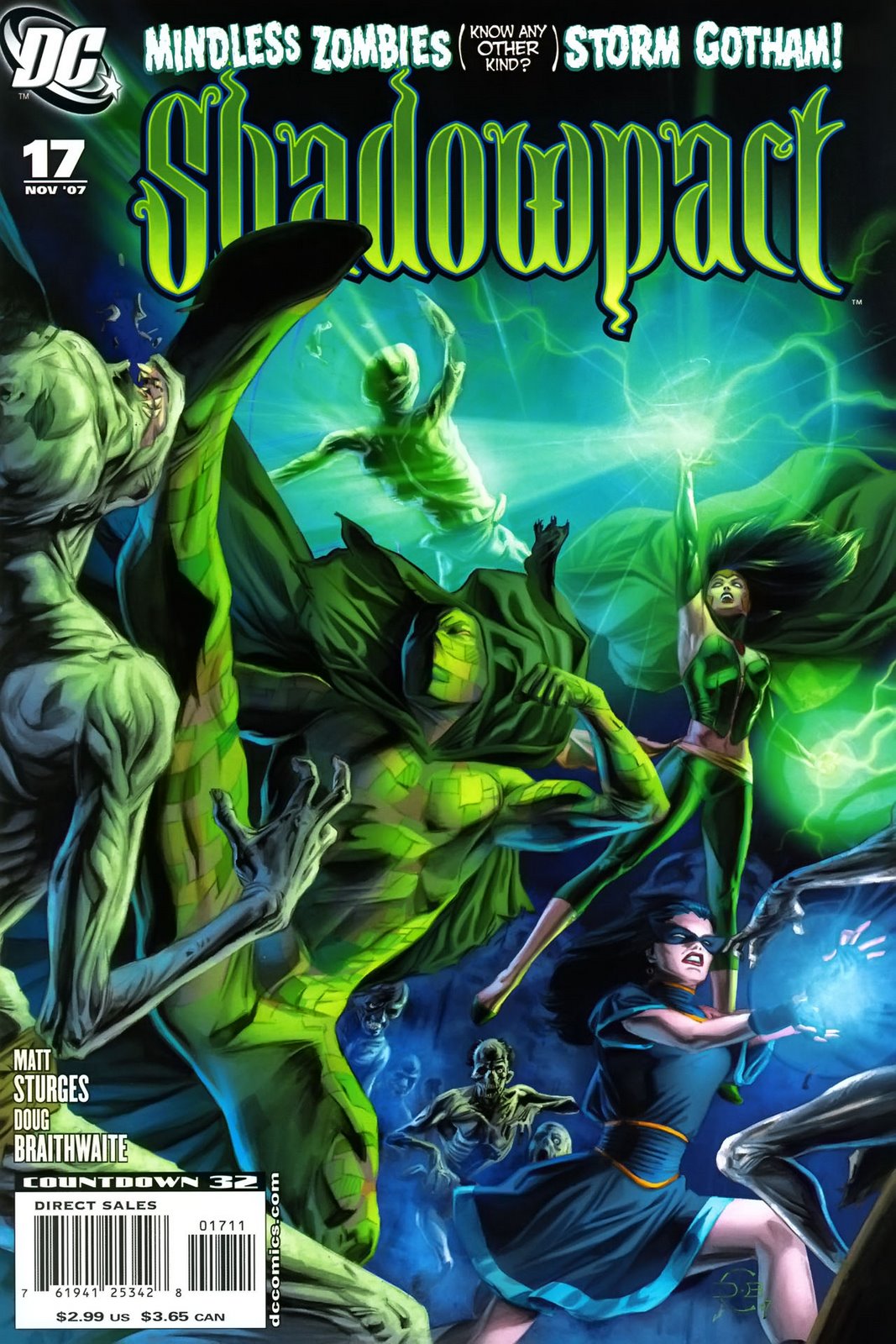
Shadowpact has consistently been one of my favorite books the last year or so, and along with All-Star Superman is one of the few superhero books DC is publishing these days that I think is consistently worth picking up. This issue marks Matt's first as scripter, and sales of the next few issues will determine the book's long-term survival. So buy copies for your friends.

Countdown to Mystery, on the other hand, is a miniseries spinning out of DC's current installment in its never ending series of crossovers. I can't speak to the quality of Gerber's half of the book, but the other half is Matt's take on the Spectre, and Plastic Man, and all sorts of stuff like that. I read the script for the first issue a while back, and it was a peach.
I haven't picked up or read either book yet, since I was chained to my desk writing a Warhammer 40K short story today, but I'll be picking them up the first chance I get. Don't miss out, and pick up copies of your own, won't you?
Bush Vs. Zombies
Further Franchise
Tuesday, September 18, 2007
The Muppet Show - Behind the Scenes
It's a bit sad to see how many of those profiled in the piece (Juhl, Hunt, Henson) are no longer with us. But at the same time, it's heartening to know that others, like Dave Goelz and Jerry Nelson, are still regularly assaying their roles, and that even Frank Oz still gets his hand up the felt backside of a Muppet from time to time.
Monday, September 17, 2007
Psst
Book Report

First up is Austin Grosman's Soon I Will Be Invincible.
This book was recommended to be from all corners, but it was Jess Nevins telling me that I should check it out that was the proverbial straw. So I have Jess to thank for his. Grossman's prose is light and breezy, and the book itself is a treat. I don't think that it's a funny as most reviewers (and Grossman himself) appear to think that it is, but that might just be because I'm so indoctrinated in the logic of superhero comics that I fail to see some of the inherent humor. I mean, of course a supergenius is going to end up evil as a matter of course, and try to take over the world. What else are they going to do with their time.
The book is an extremely loving view of a superhero universe, complete with all of the insanity and strange logic familiar from the comic book varieties. It reminded me of nothing so much as Kurt Busiek's Astro City series, and while Soon I Will Be Invicible fails to reach some of the sublime heights of the best of Astro City, it comes pretty close.
My advice to all of the reviewers who think that Grossman is blazing new territory with Invicible is to check out any of the collection volumes of Astro City, in particular Tarnished Angel and Confession.

If you're the kind of reader who has already plowed through all of Astro City and is hungry for more in the same vein, though, I recommend Grossman's novel highly. But if you do pick it up, got for the UK edition, not the American. The American volume (the cover is above) has some hokey satin-and-spandex routine as its design approach (as though embarrassed that it's a book about superheroes, for christ's sake, and trying to keep it at some ironic distance). The UK edition has a cover by Bryan Hitch (he of Ultimates and The Authority). And if the cover weren't enough, there's also a signature of color images at the back of the book, faux comic covers featuring some of the key players. Check out the link for the image gallery in this BBC interview with Grossman, or embiggen the cover above.

What can I add to the chorus of praise already heaped on this book? Not much, but I'll try. Brasyl is not a perfect book, but it comes very, very close.
Lou Anders, editorial director at Pyr (who published the US edition of Brasyl) advised me not to read the book until I'd finished work on my own End of the Century, which will be published by Pyr sometime late next year or early the year after. I took his advice, and I'm glad I did. While my own novel and Ian's are two very different beasts, structurally they are very similar, and they share some preoccupations and concerns. Maybe that's one of the reasons why Brasyl resonated so deeply with me, since it's clear that Ian and I have read a lot of the same books (David Deutsch's The Fabric of Reality least among them). Or maybe it's just that, like Ian, I very much dig the image of people with superscience sword capable of cutting through anything running around the streets of a modern metropolis.
I resisted the temptation to fire up Ennio Morricone's soundtrack to The Mission while reading the sections featuring the Jesuit priest in colonial Brazil, but just barely. But I couldn't prevent those refrains from running through my head. And believe me, the reveal of the big cathedral ship floating down the Amazon, the sculpted angels seeming to dance above the tree tops? The orchestration in that scene was amazing.
My only quibble, if I have one, is with the glossary at the back of the book. It was the same beef I had with Ian's previous outing, River of Gods. I think that both books should lose the glossary all together. They are somewhat useful tools, but neither contains all of the foreign words that I don't recognize in the text, and so rather than constantly flipping back to the end of the book to look up a word that isn't going to be there anyway, better to get them all from context, as I have to do anyway with the unlisted terms. Besides, there's always Google if I just have to find a definition right away.
In any event, highly recommended. If you've been looking for a story featuring bisexual transvestite wheeler-dealers in the future, kick ass Irish Jesuits in the past, and complex TV producers in the modern day, complete with knives that will cut through the bonds of space-time and secret conspiracies across the multiverse, then Brasyl is the book for you. And if you haven't been looking for that story, then you should be now.

I've been reading a lot of franchise fiction lately, research for some upcoming work, and much of that reading has been in the universe of Warhammer 40K. Prior to this summer I knew very little about the franchise, aside from the fact that it was tied into a table-top war gaming system, and involved space war in the distant future. Solaris, the publishers of Set the Seas on Fire and the forthcoming Dragon's Nine Sons and Three Unbroken, is an imprint of Games Workshop, who does Warhammer and Warhammer 40K, and shares editorial staff with Black Library, the in-house imprint that does the tie-in books. As a result, when I was at BEA a few months ago, flogging the Solaris books, I got a chance to leaf through some of the recent Black Library titles set in the 40K universe. Intrigued by what little I'd seen, I nagged George Mann at Solaris until he sent me a care package of the books, and dove in.
I've only read a half dozen of the novels so far, and a handful of short stories, but what I've learned is that Dan Abnett is a Bad Ass.
I knew of Abnett's work in comics, having enjoyed the stuff he's cowritten with Andy Lanning, and in particular Majestic, their run on Legion of Super-Heroes, and the ongoing Nova series. Having admired his comics work, though, I was still completely unprepared for how good his prose would be. The writing itself is often very spare, with the occasional poetic flourish, but the level of invention is just staggering. I've been reading a bunch of the source material and game manuals for Warhammer 40K the last few months, so I know where Abnett is pulling some of the bits of worldbuilding from, but the uses to which he puts that source material is often little short of revelatory.
There was a time when I railed against franchise novels, and if I still harbored those prejudices I'd have been denied the shear pleasure of reading Eisenhorn. An omnibus that collects three novels featuring Gregor Eisenhorn, an Imperial Inquistor, Eisenhorn isn't just one of the best franchise books I've ever read, it's one of the best science fiction novels, franchise or no, that I've read in ages. Really remarkable work. And recommended to any reader of quality SF. Knowledge of the Warhammer 40K universe (or, in fact, even knowledge that there is a Warhammer 40K universe) isn't required to appreciate the book's qualities.
Okay, that's enough bloviating for one week. I'll try to do another book report next week, assuming I've finished a new book by then. But don't expect to get three books in a week again, anytime soon. Having read these three in the last few weeks, though, and admired them all, it seemed a shame not to cover them all.
Labels: bookreport
Sunday, September 16, 2007
New Review
The book is well-paced, but I felt that the encounter with the islanders was dwelt upon for a little too long in comparison to Hero and his crew discovering what fate befell the crew of the Spanish Galleon: this could have been expanded upon as it turns out to be an intriguing conclusion to a mystery that is set when Hero encounters the two crewmembers of the Spanish galleon adrift at sea. However, the tale is given authenticity by the small details considered by the author - for example, language barriers, social hierarchies within the natives and conflicts between the ship's crew. It's touches like that which make the book an engaging read and one that must surely fall into the sub-genre of 'so old it is new'.
You do not need to have read Paragaraea before reading this book, but it would be advantageous to do so in order to have an insight into the character of Hieronymus Bonaventure and the encounters he has along the way. This book is likely to appeal to anyone wanting a good old-fashioned yarn, or historical fiction and the dash of fantasy along the way adds an appealing twist.
Labels: reviews
Friday, September 14, 2007
Career Day
There's another one of those take-a-test-and-post-the-results memes going around, this time about careers. I've seen it all over, but it was Klima's post that finally goaded me into participating. Here are the rules:
1. Go to http://www.careercruising.com/
2. Put in Username: nycareers, Password: landmark.
3. Take their “Career Matchmaker” questions.
4. Post the top umpty results:
And here are my results:
1. Anthropologist
2. Website Designer
3. Archivist
4. Historian
5. Cartoonist / Comic Illustrator
6. Desktop Publisher
7. Fashion Designer
8. Multimedia Developer
9. Activist
10. Political Aide
11. Writer
12. Print Journalist
13. Market Research Analyst
14. Graphic Designer
15. Computer Animator
16. Artist
17. Critic
18. Medical Illustrator
19. Translator
20. Public Policy Analyst
21. Industrial Designer
22. Potter
23. Craftsperson
24. Public Relations Specialist
25. Communications Specialist
26. Criminologist
27. Interior Designer
28. Animator
29. Video Game Developer
30. Exhibit Designer
31. Webmaster
32. Computer Trainer
33. Computer Programmer
34. Electrician
35. Corporate Trainer
36. Business Systems Analyst
37. Sport Psychology Consultant
38. Musical Instrument Builder and Repairer
39. Web Developer
40. Editor
Free Fiction Friday: "Rogues Gallery: Aria Fox"
I'll kick things off with a selection from the long-unavailable Cybermancy Incorporated, which is part of the larger Bonaventure-Carmody sequence (which also includes Here, There & Everywhere, Paragaea, and Set the Seas on Fire). The titular character of this stand-alone chapter, Aria Fox, returns in late 2008 or early 2009 in the pages of End of the Century, the next installment in the sequence.
by Chris Roberson
As she slipped through a fifth floor window into the Hofburg, the streets of
Once inside, positioned carefully in a gap in the security net of infrared tripwires, motion detectors and cameras, Aria slipped on a pair of lightweight goggles cabled to the heavy pack on her back. With the flip of a toggle switch on the wrist-mounted controls, a heads-up display pinked the corner of her view, a multicolored grid superimposed over her field of vision. From architectural plans, remote surveys and her own carefully compiled notes, Aria had mapped out a route through the galleries and hallways of the Hofburg to her target that steered clear of any security triggers. The path flashed bright green in front of her on the display, serpentine and zigzagging across the marble floors, sometimes up and over furniture or display cases, bending off out of view. She would have to duck and jump now and again, but all in all it was one of the easier mazes she’d had to run. The Hofburg would do well to upgrade their security.
Cinching the shoulder straps and cross belt of her pack tight, she set off across the floor, crouched low.
###
From her mother, Aria Fox had inherited little. By the time Melody and her sister were gone, the family fortune had been spent, the homes and estates sold or bartered off, and any odd items of sentimental value lost to flood or fire. What little Aria had inherited, though, consisted primarily of a love for excitement and what seemed a genetic propensity for danger. Raised from an early age to carry on in the family business, with her mother out of the picture Aria had decided to strike out on her own. She became a thief.
###
Acquiring the target proved even easier than Aria had expected. For all of its security improvements over the years, the Hofburg was in many respects still a product of the Seventeenth Century. Despite the high tech surveillance equipment she’d had to circumvent to come this far, the casing around the target consisted of little more than tempered glass reinforced with steel, with an electronic trigger wire and a pressure sensitive base. Child’s play. Within minutes, she held the target in her hands. The Spear of Longinus.
The principal for the job, a moneyed cabal of eccentrics, had hired Aria to obtain any number of odd bits of esoterica over the years. Reliquaries of saints’ knuckle bones or little toes, purported pieces of the True Cross, supposed Grails and enough mystic shrouds to paper the walls of Aria’s modest home in
###
From the stories her mother and aunt had told her as a child, Aria had always known that some people would believe just about anything, not least of which Aria’s mother and aunt. She had always considered it either a sign of shared insanity, or a joke that the two women hadn’t known when to drop, but through all their years together, from Aria’s earliest memories to the moment she became an orphan, the two women had persisted in telling Aria the most outrageous of bedtime stories at all hours of the day and night. Floating islands, haunted ships, Nazi werewolves and living brains in jars. Anything and everything, and all of it, they claimed, the absolute truth.
Of course, these were also the women who’d tried to get her to believe in Father Christmas and the Tooth Fairy.
###
Through her agent Hughes, who arranged all of her jobs and provided any necessary details, Aria had got a general overview of what this Spear of Longinus was supposed to be, and just what it was supposed to do. As she encased it in a self-inflating foam carry-all, which she then secured to her belt, she ran through what she knew. The retreat from any job tended to be the time when most thieves slipped up, overconfident and cocky, but Aria had found years before if she occupied her thoughts and let her feet go where they knew to go, she avoided difficulty more often than not. She’d made it in without incident, and getting out was just a matter of retracing her steps.
The Spear of Longinus, supposedly that which pierced the side of the crucified Christ, had passed through any number of hands in the last two thousand years. As legend had it, anyone who carried the Spear in battle was ensured victory, the thing amounting to some sort of supernatural trump card. Constantine the Great, Attila the Hun, Justinian, Charlemagne, Barbarossa, all had counted among their assets the metal tipped lance which had perforated Jesus, and as a result all of them had carried the day in battle time and time again. Napoleon had tried to snatch the thing for himself before marching to
Aria’s clients for this particular job, Hughes had told her, simply wanted the Spear to round out their collection of mystical artifacts and supernatural ephemera. It hardly mattered to her what they did with it. So long as they made a timely deposit into her account, they could cover the thing in puff paint and glitter and use it for a chew toy. Aria believed in the supernatural attributes of the Spear about as much as she believed that she’d get a quarter from a gossamer-winged sprite if she were to get one of her teeth knocked out in a fight.
Still, ducking under infrared beams and padding past motion detectors, Aria couldn’t help but wonder what it would mean if the Spear actually did work.
###
In the years since she’d first established herself as a top flight thief, Aria had been able to pick and choose the jobs she took as she liked. The purse from any single job was usually enough to keep her in fine foods and wine for a year or more, with the rest going to her ever growing savings account, while the traveling expenses included as part of her price meant that she could go pretty much wherever she liked. As a rule, though, Aria tended to take a job from anyone once, and provided they paid up on time and there were no complications, she’d continue to take assignments from a client as many times as they required her services. As a result, she’d inadvertently cultivated a small stable of customers who called upon her once every few years, whenever they needed a discrete acquisition for their collections.
After a few years at the job, though, Aria had found that the glamour was beginning to fade. If you’d broken into one world class museum and carted off priceless antiquities, you’d broken into them all. With the money she’d already socked away, Aria knew, she could probably never take another assignment and still live in the style to which she’d grown accustomed; but she kept on, job after job, hoping to find one that would get her pulse racing as that first job had, that would reminded her just why she was alive.
She was still looking. This
###
Back on the roof, reeling in the last of the line she’d used to haul herself up and packing it in a long, flat aluminum case along with the rest of her gear, Aria tried to imagine what the world would be like if conquered by some schmuck off the street. If the Spear in the foam carry-all actually held supernatural powers, and it were to fall into the hands of one of the faceless millions, what would that mean to the world? And, more to the point, to Aria?
She’d met only a representative of the odd group of eccentrics who were the principals for this job, the same thin twitchy man with the sunken cheeks on a half dozen different jobs. Hughes was the one who got the assignments for Aria, who made all the arrangements and scheduled the payments, but he seldom if ever met face to face with any clients. Aria herself only did at the end of every job, when she handed over the merchandise. At the beginning, she’d gone the route of making drops into unmarked mailboxes, or in coin-operated lockers at bus and train stations, but after one or two gaffs, she’d decided it was best to use the face to face meet. Then, whatever happened to the merchandise after the exchange, or to the carrier for that matter, was someone else’s problem and not hers.
The twitchy guy with the sunken cheeks was scheduled to rendezvous with Aria at Heathrow airport in two days’ time. Aria had only to fire a high tensile line across the plaza to the building opposite, making sure the grapple was secure, and then slide across, take the service elevator to the ground, and hop in the rental car she had parked and waiting for her there. A leisurely drive over the European countryside to
Then she tried to imagine a world ruled by the twitchy guy with the sunken cheeks. Aria always had to bathe right after meeting with the man, the path of his gaze over her leaving an almost tangible slime trail. He’d tried to shake her hand once, at the beginning. He hadn’t made that mistake again.
Aria fired the grappling line across the courtyard, and patted the foam carry-all at her hip.
She knew an art forger in
She slid across the line, landed noiselessly on the roof opposite, and by the time she reached the car parked below, Aria had made up her mind.
###
Driving the wide road into
“Hughes,” came the transatlantic response, matter of fact.
“Hey, baby,” Aria answered, “it’s me.”
“How do, me?” Hughes answered. “Everything go alright?”
“Smooth as silk,” she replied. “But I need you to do me a favor. Call up the principal’s rep and let him know I’ll be delayed twenty-four hours, so we’ll need to push back the drop.”
“What’s wrong? Run into any problems?”
“No, nothing like that,” Aria answered. “I’ve just got some business to take care of in
“Until the heat dies down?” Hughes offered.
“Sure, why not? Until the heat dies down.”
“You got it. By the way, I’ve got a new job lined up for you, if you’re interested. I know you wanted to take a break, but this one comes with a big price tag. The same clients as the
“No shit,” Aria said. She had been looking forward to some time off, but at double her usual rate she’d be able to take the next two years off and not feel the sting in her wallet. “Okay, what’s the story?”
“A simple snatch and grab,” Hughes answered. “Some outfit called the Carmody Institute out in Recondito.”
“Hmm,” Aria hummed, thinking it over. She’d never been to the city, though she’d spent more than her fair share just up the road in
“You got it,” Hughes replied, and broke the connection.
Aria ran her tongue over the front of her teeth, thinking things over. Her art forger friend had agreed to do a rush job duplicating a two-thousand-year-old wood and bronze spear, which would be good enough to fool any expert the client hoped to hire. The real Spear would look nice over her mantle back in
She’d heard Recondito was nice this time of year, which was a plus, but the job sounded just like any other. So much for a little excitement.
Copyright © 2007 Monkeybrain, Inc.
Labels: freefiction
The Lost Saucer
That's nothing. I actually watched and enjoyed this...
And if that's not bad enough, I have somewhat fond memories of this trainwreck, as well.
Thursday, September 13, 2007
Super Martian Robot-Girl
I hadn't known that Dorkin and Dyer were involved with the show when Georgia and I first started watching it, but as soon as we saw the first segment with the young superheroine Super Martian Robot-Girl, I recognized the style immediately.

Dorkin talked a bit about Super Martian Robot-Girl in an interview last week.
We’re developing the animation and characters and backgrounds for the “Super Martian Robot Girl” segments, which were originally a series of live-action shorts, based on the “Spider-Man” segments from the Electric Company, if you’re old enough to remember that—or old enough to rent it now. Easy Reader would be reading a Spider-Man comic, and then they’d push in on the comic and show what’s in it, with a live-action segment. For Yo Gabba Gabba, they were doing that. We designed the Super Martian Robot Girl costume and the comic book that she’s in. They wanted it to look like one of those $1.50 Marvel Treasury books from the 70s, which was pretty cool.As much as I love the animated bits as they are, how cool would those live action bits have been?
The segment was killed by Nickelodeon—they didn’t like the live-action. It was going to be talking animals and monsters, with some cartoonishly dressed people who would then call the superhero character to come and save them. The show was for preschoolers, and I think they thought the segment was a little off-putting and creepy. Some of it looked a little like homemade 70s theater—cardboard sets, purposefully looking very theatrical. It didn’t work, but they wanted to save the segment, so they did it in Flash animation and asked us to adapt it. They had audio tracks for eight or nine segments. Long story short, we ended up doing a pilot segment, and Nickelodeon liked it and wanted more, which consisted of redesigning all off the characters, from all of the material that was shot, redesigning all of the background, and then doing a bunch of limited animation poses.

Tuesday, September 11, 2007
Masked Justice
This last year I've been extremely impressed with the new Lone Ranger series put out by Dynamite Entertainment, with scripts by Brett Matthews, interior art by Sergio Cariello and Dean White, and covers by John Cassaday. I recommend the inevitable trade paperback collection highly.

A few months ago it was announced that Dynamite would be adding a new Zorro series to their lineup, as well. And that Matt Wagner would be running the show, providing scripts and "art direction." Well, today sees a new interview with a few more details, and the first look at Wagner's take on the character.

Looks pretty good so far. I'm cautiously optimistic about the series. Wagner's Mage and Grendel were formative influences on me, and while I'd prefer to see him doing more personal work like that, if he's going to be servicing trademarks I'd rather see him do something like Zorro than more Batman work.
Monday, September 10, 2007
I Am Not Interesting Today
And other than thinking that the Iron Man trailer looked about perfect, considering the source material and the need to update it for a modern sensibility (and including the best use of Black Sabbath tune in recent memory), nothing remotely interesting flitted across my visual field today, either. So maybe this whole not-interesting thing is a more wide spread occurrence, after all.
Ho hum.
Friday, September 07, 2007
Ultimates proposal
The pitch that resulted in my X-Men novel wasn't the first Marvel superhero project I proposed to Pocket. That dubious honor falls to my pitch for an Ultimates novel. This is one that history has overtaken, as the Marvel comics set in the Ultimate Universe have ended up using some of these concepts in different ways than I'd intended. But what the hell? As near as I can tell they've done the Silver Surfer in two completely different ways in the last two years alone, so maybe they're large enough to contain multitudes. Either way, I imagine that wasn't the reason the pitch didn't stick, but instead that Pocket had already lined up the very talented Alex Irvine to do a book with the Ultimates, which has just been released.
Really, though, all I wanted to do was write a Nick Fury, Agent of SHIELD story, which is readily apparent to anyone who reads the pitch. This is a spy story in superhero drag, and the bad-ass "Samuel L Jackson as Nick Fury" is the pivot around which the plot turns.
An Ultimates novel proposal
by Chris Roberson
Prologue: A few years before Nick Fury takes over as Director of SHIELD, when he is just a field agent, he has a run in with a mysterious figure who known only as Scorpio. Fury prevents Scorpio from doing whatever he was doing, but Scorpio gets away clean, and SHIELD never learns his identity or what he was ultimately after.
The story picks up a few years later, shortly after the Ultimates successfully repel the Chitauri invasion (placing this story after the events of Ultimates Vol. 1, but before the opening of Ultimates 2). The core team of Ultimates—Captain
Fury then relates the events leading up to the
A few weeks before, a SHIELD recovery team had been in
Off the coast of
The first sweep of the ruins removed all doubt that the Chitauri had used it as an underwater base. The temple had been submerged for at least three thousand years, possibly longer, and aside from fish, crabs, and a few squid, no one had been down there in all that time. The investigation of the temple site, though, raised more questions than it answers. The experts with which the team was in communication had no idea what culture produced the temple ruins, but it was clear that the temple builders were from a fairly advanced society. The technology evident in the construction and design of the ruins suggested a culture on a technological level with the late nineteenth century
The SHIELD team was ordered to secure the area, and relocate the stele to the nearest SHIELD base for further examination. The team loaded the stele into a helicarrier, and transported it to the SHIELD installation in
Only days after the stele reached the
Fury finishes recounting the events leading up to the
During the clean up of the Queensland installation, sensitives from SHIELD’s Psi-Division were sent in to sweep the facility, to use psychometry to dredge up any intel on the attackers that they can find, but all the team is able to produce is a single word: Zodiac.
Black Widow says that she has heard rumblings of some sort of criminal cartel by the name of Zodiac, through back channels with old contacts in the Russia Mafia. Tony Stark mentions that he was once approached to join some sort of secret fraternity, and while he was never told any details, the name “Zodiac” had been dropped a few times. Finally, Steve Rogers says that during WWII he had been in a raid on a Nazi installation that was part of a project code-named Zodiac.
Fury says that SHIELD doesn’t know what Zodiac might mean, and are willing to follow any and all leads that might lead to the recovery of the stele, and the apprehension and elimination of those responsible for the raid.
The team is split up into smaller groups. Black Widow and Hawkeye travel to
Investigating a half-dozen leads on several continents, the Ultimates slowly begin to discover that all of these different Zodiac are in fact part of the same organization. What they had initially seen as either a small criminal cartel or an exclusive club or a secret scientific research project, they now begin to recognize as a highly organized and efficient international cabal of extremely powerful individuals and groups.
Tony Stark’s acquaintance is a member of this organization, and had been feeling him out as a possible recruit, years before (before the Iron Man project was made public, and before Stark was a member of the Ultimates). With the help of Shadow Team operatives Quicksilver and Scarlet Witch, Stark orchestrates the abduction of his former acquaintance, and he is brought back to the Triskelion for interrogation.
What SHIELD learns is that this “Zodiac” organization has a farther reach than they had suspected. The Zodiac are the real shadow cabinet, the actual powers behind the scenes. Their members, always twelve in number, are among the most power individuals on the planet. Their existence is almost completely hidden, and even power brokers like the Bilderburgs and the Illuminati are only dimly aware of their existence. In addition, the identity of each of the members of the Zodiac is known to only a handful of other members, the rest knowing them only by their secret call sign. When a member dies, a new replacement is selected by the members who immediately precede and immediately follow their signs in the precession of the constellations across the heavens, and for the most part, the identity of each member is known only by those who selected them for membership. What is more alarming, Zodiac controls entire countries and corporations. Even within the
Before they can learn more from their captive, though, Stark’s associate manages to self-induce a brain hemorrhage using some sort of hypnotic trigger, and even Psi-Division can’t unlock any secrets left in his ruined mind.
So SHIELD now knows that Zodiac exists, though they don’t know where their base of operations can be found. But why would an international power cabal like Zodiac run the risk of exposing themselves with daylight assaults on SHIELD installations, only to steal millennia old relics from a forgotten temple?
The answer lies in the origins of the organization itself. Captain
At the same time, Hawkeye and Black Widow and drawing on their black ops experience to trace connections from the Russia Mafia to Zodiac, discover and penetrate a highly secured stronghold, filled not only with weapons-grade plutonium, missiles, firearms, and ammunition, but with centuries-old statues and objet d’art, illuminated manuscripts dating back to the middle ages, Renaissance paintings and ancient tapestries. Throughout the books, paintings, tapestries, and sculptures is repeated again and again the same images: the twelve signs of the Zodiac, surrounding a twelve-sided figure. Hawkeye and Black Widow photograph and scan as much of the material as they can, transmitting it back to the Triskelion, and then exit the stronghold in a hail of arrows and gunfire.
While Tony Stark, armed with the identities of two of the ruling members of the Zodiac, tries to infiltrate the organization at its highest levels, SHIELDs technical experts work on decoding the information sent back by Hawkeye and Black Widow, and to decrypt the data recovered by the Wasp in
SHIELD, using all of the information at their disposal, discovers that Zodiac is far older than they could have guessed. The Zodiac has its roots in a medieval secret society, in the vein of the Knights Templar. This ancient organization, Ordus Clavis Zodiacum, or Order of the Zodiac Key, was dedicated the finding the mythical artifact which was said to be more powerful than the philosopher’s stone, or even the Holy Grail itself. With the Zodiac Key, it was said that man could unlock the secrets of creation itself, and rewrite reality to his whim.
Even those who thought that the Zodiac Key was anything but a legend, though, admitted that it had not been discovered in millennia, and that no man living knew where it could be found.
In the secret writings of the Order of the Zodiac Key, though, were mentions of an ancient civilization on the far side of the world, who once found the Key, and in using it destroyed their world. Their homes and temples were swallowed beneath the waves, never to be seen again.
The ruined temple found in
Captain
It is a race, then. The Ultimates have to locate and contain the members of the Zodiac before the Zodiac Key is located.
Tony Stark infiltrates the Zodiac ruling council, after Fury manages to stage a particularly convincing public drama in which it appears that Stark has been expelled from the Ultimates for stealing and selling state secrets. Stark, brought before the Zodiac council, is secretly transmitting back everything he sees and hears. There, in a position of leadership among the Zodiac council, is Scorpio, the man who Fury faced years ago, the one who got away.
Scorpio and the rest of the Zodiac council mobilize their full forces, having discerned the location of the Zodiac Key. Several of the members of the ruling council are mutants, with powers corresponding to their sigil, while others (like Cancer) have technological weapons or suits of armor at their disposal. They have operated in the shadows for long centuries, but with their end game in sight, they are coming out into the light.
Acting on the intel provided by Stark, Fury orders the Ultimates and a full tactical team of SHIELD field operatives to move out. The Ultimates arrive too late, and Scorpio already has the Zodiac Key in hand. A twelve-sided dodecahedron, with strange sigils carved into each of its twelve faces, it is about the size of a man’s head and seems to glow with an eerie light from within. There is a stand-off between the forces of the Zodiac and the assembled might of SHIELD and the Ultimates, when everyone present “hears” a voice from the Zodiac Key, speaking in their thoughts.
It is revealed Zodiac Key is an alien artifact of an ancient world, dead billennia ago, that grants one the ability to rewrite reality at the quantum level. It was last found by man eleven thousand years ago, and its brief use by a member of an advanced island culture in the
The Ultimates gear up. Now they have even more reason to see Scorpio and the rest of the Zodiac get taken down. A tremendous battle followed, with the powered members of the Zodiac ruling council on one side, and the Ultimates on the other. The Ultimates win, but at considerable cost. In the end, the Zodiac Key falls into the hands of SHIELD, who secret it beneath the Triskelion. The Ultimates, amongst themselves, are unsure whether they are comfortable with that much power being in the hands of men, whether SHIELD or anybody. Fury has the last word, and his word is that if anyone has to have their trigger on doomsday, he wants it to be him.
Hugo Changes Poll
- Prize draw for voters
- On-site voting
- Cheaper voting
- Free voting
- Free e-books for voters
- Split Best Novel
- Add a YA category
- Better involvement of online works
- Fewer voters
- Do nothing
Go and vote your opinions, and maybe we'll see some changes for the better in the way the Hugos are run. The last few years have seen some really positive changes to the awards for artist and editor, thanks to the tireless efforts of a few generous folks, and serve as proof positive that participation is the key to improving the process.
Thursday, September 06, 2007
Lucy, Daughter of the Devil
Then go watch the first episode of his new series, Lucy, Daughter of the Devil.
Then fire up your Tivo or PVR of preference, set the Season Pass option, and settle back.
(Or, in the event that she's not to your tastes, you could always try WordGirl, the new educational kids series from Soup 2 Nuts, who produced all those terrific shows I mentioned above, plus gems like Hey Monie and my personal favorite, O'Grady.)
Captain Action proposal
A few months back Moonstone Books announced a contest, inviting pitches for a relaunch of the Captain Action character, best known as an action figure in the sixties. It was too tempting to pass up, so I spent an afternoon putting together a pitch and sent it off to them. So far as I know Moonstone never officially announced the winner, and a search of their website doesn't turn up any references to the contest at all, but a while back Fabian Nicieza mentioned in an interview that he would be scripting Captain Action for them, so apparently he "won." I thought maybe that Moonstone would make some kind of announcement to their mailing list or put a note on their website, but hey, what do I know?
Anyway, here's my pitch for Captain Action, which is kind of like Last Action Hero mixed with The Matrix by way of Megazone 23, with a bit of Captain Marvel tossed in for flavoring. Or something like that.
Imagination Unshackled
by Chris Roberson
The central appeal of the Captain Action character, which the short-lived DC Comics series unfortunately abandoned, was his ability to become other heroes. Of course, licensing would prevent any new Captain Action series from using the same characters that the original Ideal action figure could become, but the use of surrogates—close enough to be recognized as specific archetypes without crossing the line into actionable infringement—could fill that need: the Superhero, the Pulp Avenger, the Jungle Lord, the Masked Gunslinger, the Spaceman.
The question is, then, what sort of world would need a hero that could turn into other heroes? The answer is, a world completely without heroes, real or imagined. A gray world, a world without imagination, a world without hope. A world that needs one thing: Action!
Conceived as a kind of Dial-H-For-Hero in The Matrix, this Captain Action is an allegory for the power of the imagination in an unreal world overdosed on reality.
The Setting
In the near future, Earth is rendered uninhabitable by a devastating asteroid impact. Only a few million survivors huddle in underground bunkers. Humanity’s only hope for long-term survival is to journey to another habitable planet, but the nearest one detected by astronomers is dozens of light-years away. The journey will take hundreds, even thousands of years. Worse, the amount of fuel required to propel even a small spacecraft across the interstellar distances is prohibitively high. The best that can be managed is to send a starwisp, a small robotic craft not much larger than a soda can, propelled by light-waves.
Scientists devise a solution. They have perfected a means of uploading human minds as digital consciousnesses. All of Earth’s survivors can be uploaded into a computer, which can then be integrated into the starwisp and sent to the distant star, along with nanoscopic machinery that will use available organic material at their destination to fabricate new bodies for the digital survivors. After a journey of centuries, the survivors will be downloaded into new bodies on another world, and a new home for humanity can be built. On their arrival they’ll have access to a complete library of all human knowledge, every book ever written, every discovery ever made, stored within the starwisp itself.
There is, however, a problem. The scientists have determined that a human mind in digital form cannot be kept in storage, simply saved as a file, but must be kept active to keep it from corrupting. As a result, the minds stored within the starwisp are kept in a simulated virtual environment, that seems to them as real as the physical world they have left. Early tests of digitally uploaded consciousness revealed that minds which became aware of their true nature, and of the unreality of their virtual environment, inevitably went insane and became unusable. To prevent this, in the starwisp computers safeguards have been put into place, to stifle any stimulus that could trigger such realizations. The survivors memories are edited, such that they remember nothing of the asteroid that devastated Earth, or their own desperate attempt at survival. So far as they know, they live in an early 21st century city, carrying on normal lives.
The safeguards the scientists put in place include a complete prohibition against any flight of fancy, any entertainment that could lead the survivors to contemplate the unreality of their situation. There is no fantasy, no use of the imagination, and no heroes.
Until Captain Action comes along.
Stanley Weston is a television scriptwriter. Like everyone he knows, he lives in the City. It is a dreary, drag, gray place. Weston works on shows about the cops that patrol the city streets, or the doctors that work its hospitals, or the lawyers that plead their cases in its courtrooms. Weston often feels that he keeps writing the same sorts of shows, over and over again, because that is the only thing the networks will allow.
But Weston has dreams of doing something a little more colorful, a little more experimental. All about a man who wears a colorful uniform and has adventures, travels to exotic locales, fights against evils and injustice. A man called Captain Action. No matter how hard he tries, though, he can’t interest any of the networks or any producer in his idea. He’s shown the door, time and again. And worse, his repeated attempts have brought him to the attention of the Monitors.
The Monitors are responsible for reviewing all of the programming on all the networks, all of the content of books, magazines, and newspapers, ensuring that it all accords with the City Standards. Weston knows that his Captain Action concept threatens to violate several of the Standards, but he’s convinced that the regulations are too restrictive, and that the audience would respond to his ideas, if given a chance.
He won’t be given that chance. The Monitors come for him. Weston has known people who have come to the attention of the Monitors. When the Monitors get through with someone, they’re not the same ever again, but seem as though something has been erased from their minds. They’re more walking zombies than thinking human beings.
Weston doesn’t want that to happen to him. He runs. He flees into the City’s subway system, and finds himself in an abandoned station. There is an ancient old man there, who knows his name. The ancient man says that he has a secret to share with Weston. He turns on lights, and the darkened station is revealed to contain an incredible library, full of books with striking covers, pulp magazines featuring masked heroes, comic books with colorful superheroes, movie posters, film reels, and more. Weston doesn’t remember ever seeing a book or movie or show that was about anything but the drab gray City that surrounds him. Where did all of this come from?
The ancient man reveals to Weston that his world is not the world. It tells him about how the Earth died, and the survivors were encoded as digital incarnations in a computer and sent to the stars. It explains that his mind and memories, like those of everyone else in the virtual City, has been edited to remove any trace of imagination which might threaten the stability of the City. The library he sees around him is a representation of the digital archive stored deep within the starwisp, to be retrieved when they arrive at their destination.
The ancient man, moreover, is not a human at all. He’s a subprogram of the starwisp computer, tasked with maintaining the digital archive. But the subprogram has become convinced that the Monitors, the programs responsible for enforcing the prohibitions against imagination, are removing everything that is vital and vibrant about the human minds they are supposed to be protecting. The archive subprogram has become convinced that if things continue as they have, the survivors who reach the distant star won’t really be human at all, and not worth saving. It has found Weston, then, to give him the ability to fight against the Monitors.
Now that Weston knows that his world is only virtual, and his capacity for imagination has been restored, he can use his own imaginative capacity to change the world around him. He can change into the characters from the books and comics in the hidden library, and call upon superhuman powers. Taking the forms of the forgotten heroes of a more colorful world, and the name of his cherished fantasy, Captain Action struggles against the gray forces of the Monitors, to free the minds of his fellow humans.
Moorcock on Moore
And I know that for me he is the only person writing comics whose work I now automatically buy and look forward to reading. I can never get enough of Moore’s work. It was Moore who brought me back to comics, who made me raise my own ambitions in the work I did in the 90s and in my Elric comics. All this culminated in the huge pleasure of being invited by him to write a two part Tom Strong adventure. He had shown me that it was possible to address a sophisticated audience which he had almost singlehandedly created.Moorcock also mentions his appearance with Moore last year on stage at the Vanbrugh Theatre in London, which you can hear (albeit in perhaps less than pristine recordings) over on Multiverse.org, the nexus of all things Moorcock. Your mileage may vary, but there are not two more significant influences on me, as writer and reader, than these two bearded Brits. The conversation between the two is a fascinating one, and I'm glad it was captured for posterity.
Wednesday, September 05, 2007
MonkeyBrain Books Two-for-One Sale
Untitled Firefly Proposal
With that limitation in mind I went off and put together what I thought was the Best Firefly Idea Ever, and sent it off to Pocket for their consideration. One thing lead to another, the movie came out and maybe didn't do as well as it could, and for whatever reason the proposed line of books never eventuated, with Keith R.A. DeCandido's novelization of the film being the only Serenity book to see release, so far as I know.
Digging around on my hard drive the other day, I came across my original proposal, which has been gathering dust for the last few years. It's not much use to me now, but I thought someone out there in internetland might be interested in seeing what might have been, if the line had gone forward and Pocket and Whedon had been somehow duped into letting me write an entry for the franchise.
So here, warts and all, is my Untitled Firefly Proposal, for your amusement. (And clearly, not knowing who lived or died in the film when I wrote the outline, there are some very unworkable bits of the plot mechanics.)
[The high concept here is to bring Mal into conflict with a dark mirror version of himself, someone from a similar background who followed a different path. Intertwined in that conflict is a woman who isn’t quite what she seems, and her mysterious cargo. Comments on the plot are set aside in brackets.]
The crew of Serenity is on some high class planet near the central core. This is the big city, lots of high rise buildings, pleasure palaces, and government offices. There’s also a thriving black market at the spaceport, since people with money don’t always spend it on things that are strictly legal.
Mal has brought Serenity here in search of work. They’re down to their last dimes, and don’t have any prospects on the horizon. He hears about a wealthy woman who is looking to ship some cargo with an outfit that won’t ask any questions, and he thinks that they fit the bill perfectly.
Before Mal can make the meeting, though, he runs into some trouble with the local constabulary. It’s not a big deal, just a fight in the streets over the honor of the Brown Jackets, or something along those lines. Drinks are spilled, tables are overturned, and Mal gets nicked by the cops and thrown in jail. He’s just in the drunk tank for the moment, since they’re having trouble accessing the central Alliance records. At the moment, they just think he’s a drunk-and-disorderly whose jaw is out of line because he was on the losing side of the war. If they twig to the fact that he owns a Firefly-class ship that is suspected in any number of crimes against Alliance property and laws, he is going to be in much bigger trouble.
So the crew decides they’ve got to bust him out of jail. But they can’t pass up the meeting with the high class woman, or they won’t be able to afford fuel to get off the planet once they get him. So they send Wash and Kaylee to meet with the woman, while Zoe and Jayne go to bust the captain out of jail. [The only important fact here is that someone meets with the woman and someone goes to get Mal out of jail, so if any of these characters aren’t available for whatever reason, the roles can be swapped as needed.]
Mal is in jail. There are a few guys in the cell with him, and a few in the next cell over. To say that he’s surprised when he hears someone calling him by a nickname he’s not heard in years is an understatement. He’s floored. He turns around, trying to find the source of the voice. It’s in the next cell over. An old army buddy, Vince.
Vince joined the Brown Jackets the same time Mal did. They were from neighboring planets out on the rim, and went through training at the same time. They were never really friends, even in the early days, but they respected on another.
Vince was a natural soldier, and ended up in command of his own platoon. He and Mal saw each other infrequently over the course of the war, but they always had time to swap old stories and share a few drinks. Vince was hardened by the war, but he was still the same kid Mal had met on the transport, years before.
Vince stands on the other side of the bars, a prisoner in the next cell over. The years haven’t been terribly kind to him, but there’s that same smile that Mal remembers from all those years ago.
Vince says that he’s a bit down on his luck. He was in the system looking for work when he got picked up in an Alliance raid of illegal gambling den, and that it looks like he’ll be behind bars for a good long while to come.
Mal tells Vince not to worry, that they’ll figure something out.
Meanwhile, Wash and Kaylee are meeting with the high class woman with the job offer. Her job is a simple one. She’s got a case, locked tight, about the size of a coffin. What’s in it, she won’t say. All she will say is that she’ll pay handsomely for it to be delivered to her nephew on one of the rim worlds. So long as no questions are asked, of course. Her only stipulation is that her personal secretary, Adeline—a meek, prim woman who sits in the corner of the room, without saying a word—must accompany the cargo on the voyage out. The secretary will arrange for her own transportation back, but the high class woman will pay handsomely for her passage out on Serenity.
Wash and Kaylee quickly agree to the terms, and arrange to have the case brought to Serenity. Adeline will meet them there within the hour. Wash explains that they may need to leave in something of a hurry, and insist that she not be late.
Zoe and Jayne arrive at the jail. They don’t have time for subtlety. This is a brute force smash-and-grab operation, with the captain being the prize. Luckily, this is a small precinct house, so there aren’t more than a half-dozen officers posted there at this hour.
A spectacular gun battle and fight scene follows, during which Zoe manages to make it to the cells, while Jayne holds off the surviving guards. Reinforcements are on their way, and should be there any moment.
Zoe starts to burn through the bars with a handheld welding torch. Mal says that as soon as she finishes opening his cell, that she needs to open the one next to it.
Zoe says that there isn’t time.
Mal insists. He says to look who is in the cell.
Vince calls Zoe a nickname she’s not heard in years, and which she’d just as soon forget.
Zoe gives a sly smile, recognizing him immediately. She goes to work on the cell’s bars, insisting that she’ll get them both out in time.
Zoe, Mal, and Vince race back to Serenity, with Jayne bringing up the rear. Jayne thinks the fun part of this little escapade is just about over, since the reinforcements have arrived. It’s time to move on.
The jail-breakers and jailbirds arrive at Serenity just as Adeline and the coffin-cargo show up. Everybody gets on board quickly, and the ship takes off, one step ahead of the law.
Everybody is settling in on the ship. Adeline is given one of the remaining guest rooms, with the coffin-shaped cargo container stowed in her room. Vince bunks out in the shuttle, since they don’t have any other rooms.
[This part of the story is mostly about the character interactions, and as such assumes that the crew’s complement will be the same as on the series. The plot points can be tweaked in the event that things shake up.]
[However, at the outset, the idea is that there will be two major threads going through this part. One will be between Mal and Vince, with Zoe and Wash as significant players.]
Once they’re out of sight of the high class core world, Vince asks Mal if he’d be willing to drop him off on a planet along their route. Vince has some friends there who might be willing to help him out. Mal agrees, and the two of them spend the next few days reminiscing and drinking. The crew is kind of surprised to see Mal tossing back so many drinks, but they chalk it up to high spirits at this impromptu reunion. Zoe sits in on a lot of these old war stories, and the chummy way that she and Vince get along makes Wash more than a little jealous. Throughout, though, there is the creeping suspicion that Vince isn’t quite the man he used to be. He seems darker, a little more mean-spirited. He’s followed a hard road, and it shows.
[The other thread will be between Adeline, Simon, and Kaylee, with bits of River at the fringes.]
Adeline is refined, composed, the portrait of the high class woman. Everything that Simon was raised to think a lady should be. He falls for her, hard. She doesn’t talk much, but he’s able to draw her out, a little at a time, until she’s comfortable talking to him. They have similar backgrounds, both coming from well-off families, both educated at the better schools. Kaylee, who at first had taken a shine to Adeline, now begins to hate her with a passion. Simon has no time for Kaylee anymore. Simon goes so far that in a conversation with Kaylee he describes how Adeline is so perfect and refined, not at all rough and rustic like Kaylee. He doesn’t mean any offence, but he’s so far gone with his infatuation that he doesn’t stop to consider what that will sound like to Kaylee until he’s already said it.
The ship travels on. They are a day away from the planet where they’ll be dropping off Vince, when Wash discovers something strange. The ship has been broadcasting a beacon for some time now, and he has no idea who set it up. It’s encrypted, and he has no idea what it might be broadcasting. He tells Mal about it, and Mal starts to get very suspicious. A ship appears on their screens, coming in fast.
Too late do they realize who must have sent the beacon. Vince corners them in the cockpit, and tells Mal to order Wash to stop Serenity dead in her tracks. That’s Vince’s people coming to collect him, and he wouldn’t want anyone to get hurt while they were around.
Vince’s ship docks, and his crew boards. They are like a dark mirror version of the crew of Serenity. Where Mal’s crew are thieves and smugglers with hearts of gold (more or less), Vince’s crew are cutthroats and villains. They are pirates, in every sense of the word. They’d as soon kill Mal’s crew as look at them. They’re almost as bad as Reavers.
Vince won’t let his crew kill Mal or his people, though. On account of their long friendship he’s going to let them live. But he will be taking all their credits, what provisions Vince might find useful, their weapons, and of course the cargo that Adeline has in her cabin.
Adeline is locked down in the operatory with the rest of the crew, and doesn’t know that they’ve taken her cargo until Vince’s ship is away. Serenity’s engines have been disabled, and it will take Kaylee at least a day to get them up and running.
Mal is all for washing their hands of the whole business. He’s furious that he was taken in by Vince. Furious that Vince would betray his trust. He wants to drop Adeline off at the nearest Alliance station with his apologies and light out for the rim.
Adeline has other plans. She does some serious kung fu and lays Mal out on the deck. While Mal is rubbing his jaw, trying to figure out how she decked him, Adeline explains that her mission is to safeguard the cargo she brought onboard, and that it means more than all of their lives combined. Serenity will go after Vince’s ship, and Adeline will retrieve her cargo, and if she has to kill them all with her bare hands and pilot the ship herself, she will.
The crew of Serenity is unarmed, since Vince’s guys took all the weapons, and none of them can match Adeline’s martial arts. What is worse, she is armed, too, producing small arms hidden on her person. Adeline is a serious bad-ass. The prim, meek and mild persona was just an act. She’s in charge now. She reveals that when she first boarded she planted several explosive devices in the ship that she can detonate at will, insurance against any possible move against her.
The rest of the crew isn’t happy about being shanghaied, but then, several of them are eager to go after Vince themselves. Jayne wants his favorite gun back. Zoe wants a bit of payback, since her trust was betrayed, too. Wash just wants to see Vince suffer. They voice their opinions, telling Mal they should go along with Adeline. Mal resists, but doesn’t have much of a choice.
With Adeline calling the shots, Serenity gets up and running, and chasing after Vince’s ship. Adeline reveals that she can trace the location of the cargo, if she’s within a few thousand kilometers. They track Vince’s ship to their home base, an old mining facility on a moon.
Mal and the crew, under Adeline’s supervision, have to storm the mining facility and retrieve the cargo. The only firearms they have are the small pistols that Adeline snuck onboard, and she isn’t giving those up. So they have to be creative.
In the action that follows, Vince ends up getting shot, and Mal is there when he dies. The cargo is destroyed, leaving Adeline unable to fulfill her contract. Vince’s crew takes to the skies, planning on scuttling Serenity as they go, but Kaylee has snuck onboard during the action and planted Adeline’s explosive devices on Vince’s ship instead. As soon as they bring their weapons systems online, the devices trigger, causing explosive decompression. The ship crashes into the side of the moon in spectacular fashion, ultimately destroying the mining facility entirely.
Mal and his crew just make it back to Serenity before the big blow. They get into the sky just in time to see the mining facility go up in a huge fireball. Riding the crest of that fireball, though, is Adeline in a little personal transport she’s commandeered from the pirate crew’s little fleet. Since she failed in her contract, she can’t go back to her employer. Her code of ethics means that she is now damaged goods, a disgrace. She is like the ronin of ancient Japan, a masterless killing machine, drifting with no purpose. But if she wanted to blame one person for her failure to complete her mission, it couldn’t be Vince, since he was dead. And besides, Vince was just the bullet. The one that pulled the trigger was the one who brought Vince onboard the ship in the first place. And that was Mal. If she ever sees Mal again, he’ll regret it.
[And that’s where we end. The status quo of the books is restored in the last pages, with the crew of Serenity out in space, broke, without any job prospects, looking for some good luck over the horizon.]
New Review
The story jumps back and forth between Hieronymus as a young boy, just beginning to learn swordplay, and as an officer aboard the Fortitude. From his early years, we learn about his excitement for adventure and what has shaped him into the man he is to become. Following Hieronymus’ adventures as a man, we’re treated to a swashbuckling good time. With action and suspense a plenty, Set the Seas on Fire is a wonderful adventure on the high seas. I didn’t even miss the absence of pirates.
Labels: reviews
Tuesday, September 04, 2007
Overdrift Stage 2
Monday, September 03, 2007
Barsoom, Hyboria, and Urban Mean Streets
This week Bill Cunningham and Christian Johnson will be discussing "Barsoom, Hyboria, and Urban Mean Streets: The Pulps and Their Modern Legacy" on the weekly online radio show Geekerati. Two of the books they will be discussing are MYTHS FOR THE MODERN AGE: PHILIP JOSE FARMER'S WOLD NEWTON UNIVERSE and the Nebraska Press edition of TARZAN ALIVE. The podcast is Monday, 9/3/07 at 7pm Pacific Time.Visit the Geekerati site for details, and to listen in your ownself.
Geekerati Radio is an online radio show which includes Christian Johnson, Shawna Benson, Bill Cunningham, Eric Lytle, and guests in a round table discussion of popular culture by geeks for geeks. Geekerati Radio is a featured show in the BlogTalkRadio network. The Geekerati Radio show airs Monday nights at 7pm Pacific.
Sunday, September 02, 2007
New Review
Michael Moorcock recommends this author, and Revolution SF describes this[snip]
book as “Horatio Hornblower meets H.P. Lovecraft.” The Lovecraftian elements of
madness, monsters, and horrible death only come out of the rocks near the very
end, and the source is actually Polynesian legend; but either way, the climax is
effective. This novel is an extended and revised version of a print-on-demand
publication by the same title. Now it is seeing the light of day in large paperback
format, and this is good news for all readers who enjoy blood and thunder naval literature in the tradition of Master and Commander.
I loved the sheer literary quality of this book: ah, King’s English! It is a complete stand alone novel, but it turns out, upon reading the Afterward, that Roberson has written a number of books about the Bonaventure clan. Titles include End of the Century; Paragaea: A Planetary Romance; and Here, There, and Everywhere, and the Dulac family crosses the Bonaventure family more than once in these volumes. So if you enjoy this book, be of good cheer! There is more in the same vein to read.
Labels: reviews
What kind of Nerd are you?

Saturday, September 01, 2007
Ultraman at the Hugos
Any Japanese speakers out there able to translate what the narrator is saying?
By the way, if you haven't seen it yet, this is this year's Hugo award.

I'm not about to turn down a Hugo any year, but that would have been a good one to take home.


