


Wednesday, February 28, 2007
The Day's Progress - Wednesday Edition
Okay, three scenes became five, and were some of the hardest to write of the book so far, but I got them through. And that's "Jubilee" done.

I'm now assuming a total word count of 140K, though I think it'll be a bit longer than that.
No sample today, as there was nothing in today's writing that wouldn't completely spoil the ending of the book. Big reveals throughout, including just what Omega is, just why the Ghost Fox is so much older than Sandford Blank, and who Jules Dulac really is.
Tomorrow I got to the post office and do some administrivia, and Friday I tighten up the outline to "Millennium," so that I can start work on Monday writing the last secton. Then I'll just need to shuffle the three threads together like a deck of cards, and the book is ready to roll.
I'm now assuming a total word count of 140K, though I think it'll be a bit longer than that.
No sample today, as there was nothing in today's writing that wouldn't completely spoil the ending of the book. Big reveals throughout, including just what Omega is, just why the Ghost Fox is so much older than Sandford Blank, and who Jules Dulac really is.
Tomorrow I got to the post office and do some administrivia, and Friday I tighten up the outline to "Millennium," so that I can start work on Monday writing the last secton. Then I'll just need to shuffle the three threads together like a deck of cards, and the book is ready to roll.


Tuesday, February 27, 2007
Business Meeting
This SNL Digital Short from last week's episode is one of the funniest things on SNL in a good long while.
More Secret Saturdays
Jay Stephens points to a promo video on the Cartoon Network site that has a few brief glimpses of The Secret Saturdays.
If you scoot on over to the Cartoon Network 'Upfronts' page and click on New Shows, you'll get a bit more buzz on my new animated series 'The Secret Saturdays', including something called a Sizzle Reel.If these little glimpses are any indication, the series promises to be made of awesome.
The Day's Progress - Tuesday Edition
By my reckoning, I'm now three scenes from the end of "Jubilee." Unfortunately, one of them presents a vexing problem, the solution for which I've not yet found. So what should be the work of a couple of hours might end up being a mite longer. But with any luck, I'll be able to finish by tomorrow afternoon. Fingers crossed.

Who am I kidding? This isn't going to be 120K words long. Not when it's already 110K and I've still got a whole act to write. It'll be a fat book, no question. But meaty...
Today Dulac faced off against the guy in the smoked-glass spectacles in a sword-fight, and we finally learned what Sandford Blank keeps in the locked room at the top of the stair. Lots of final confrontations, big reveals, and mystery's solved. The following is about the only sample I can share of the day's writing, without spoiling the end.
Who am I kidding? This isn't going to be 120K words long. Not when it's already 110K and I've still got a whole act to write. It'll be a fat book, no question. But meaty...
Today Dulac faced off against the guy in the smoked-glass spectacles in a sword-fight, and we finally learned what Sandford Blank keeps in the locked room at the top of the stair. Lots of final confrontations, big reveals, and mystery's solved. The following is about the only sample I can share of the day's writing, without spoiling the end.
The trio said their farewells to Baron Carmody, who hardly seemed to notice. Leaving the Carmody house near Grosvenor Square, it was only a short distance to the offices of J. Lafayette on New Bond Street, a matter of some four or five blocks, just up from the Doré and Grosvenor Galleries.
The photographic firm of J. Lafayette was located in a five storey building, surmounted by the queen’s royal crest in bas relief, above an image of a sunburst. The Lafayette firm, headquartered in Dublin, had only recently opened a branch in London, added to those already in Glasgow and Manchester.
The offices had just opened for the day, and Blank, Miss Bonaventure, and Taylor were asked to wait on the ground floor while someone in authority could be summoned. They were shown into the waiting gallery on the ground floor, where the handiwork of Lafayette and company were on display, in particular a familiar image of Queen Victoria on the occasion of her Golden Jubilee, ten years previous, which according to the accompanying placard had earned Lafayette a Royal Warrant as “Her Majesty's Photographer in Dublin.”
After a brief wait, the branch’s manager appeared in the waiting gallery. Blank, presenting his featureless calling card, employed a bit of persuasion, and in short order the trio were being escorted into the development labs on the building’s second floor. The heavily shuttered room smelled of chemicals, and the already developed photographs hung drying on lines strung from wall to wall, like photographic garlands.
Most of the photographs were staged against the backdrop which had been arranged in the corner of the Great Ballroom of Devonshire House. There was Miss Arthur Paget as Cleopatra and Daisy Pless as the Queen of Sheba, the Hereditary Prince of Saxe-Coburg and Gotha as Duke Robert of Normandy and the Princess of Wales as Marguerite de Valois, Frances Evelyn Warwick as Marie Antoinette and the Honorable Reginald Fitzwilliam as Admiral Lord Nelson. There was even the Baron Carmody as the Roman Briton war duke Arthur, in contrast to the more fanciful King Arthurs portrayed by the 7th Baron Rodney in full plate armor and Grosvenor in surcoat and mail. And here was the Lady Priscilla as Gwenhwyfar, in a flowing gown of samite, looking years younger with her hair cascading over her shoulders than she did in modern dress with it lacquered into a bun.
Some of the photographs, though, were not staged, but were more candid snap-shots of the Great Ballroom itself, and of the crowds milling there. The Crystal Stair curved up out of view in one shot, while another showed the serried ranks of waltzers moving across the floor. And in one photograph, in the far right side of the image, was plainly visible a man in modern dress, his hair wiry and his beard stringy, carrying in his arms a long slender case. The man’s eyes were wide and crazed-looking, and his lip curled in an expression of distaste.
It was, unmistakably, Mervyn Fawkes.
Monday, February 26, 2007
The Day's Progress - Monday Edition
A good day, as I managed to get through quite a bit of action, a murder, and an investigation.

Today, I got to the Devonshire House Ball, which has been a key part of End of the Century since I stumbled upon it by accident last spring (though I've since learned that MI8 was apparently not headquartered at the later Devonshire House during WWII, despite what some online sources report). There are an amazing wealth of resources online about this one party, and the Times article that ran the next day was particularly useful. Have I mentioned lately that I love the internet...
Today, I got to the Devonshire House Ball, which has been a key part of End of the Century since I stumbled upon it by accident last spring (though I've since learned that MI8 was apparently not headquartered at the later Devonshire House during WWII, despite what some online sources report). There are an amazing wealth of resources online about this one party, and the Times article that ran the next day was particularly useful. Have I mentioned lately that I love the internet...
In short order, Blank and Miss Bonaventure were rushed round to the servant’s entrance at the rear of the house, and outfitted in appropriate costume. They were reunited, moments later, Blank in the guise of a musketeer from the days of Louis XIII, a rapier at his side, and Miss Bonaventure as an Egyptian maiden, her eye lined with kohl, a beaded wig on her head. Her wide silver bracelet with its lenticular gem at the end of her bared arm seemed to fit the motif, offering a counterpoint to the broad collar she wore, from which depended a scarab encrusted with jewels of paste.
“Why, Blank, don’t you cut a dashing figure?”
Blank swept the broad-brimmed hat from his head, and bowed low. “Cleopatra at her finest was never as lovely.” He offered her his arm. “Shall we, O Vision of the Nile?”
They stepped through the side door, and found themselves at the foot of the well-known Crystal Staircase, its bronze-scrolled handrail gently spiraling around the glass newel. At the head of the staircase stood the Duke of Devonshire, in the dress of Charles V, and wearing a genuine collar and badge of the Golden Fleece lent to him by the Prince of Wales. At his side was the Duchess, as Zenobia, Queen of Palmyra, a grand tiara above her brow. The pair wore painted smiles, unable to completely hide their unease from the seven hundred or so guests who crowded the Great Ballroom.
The guests had been arriving for nearly an hour, though the quoted arrival time of half-past ten had only just struck, and crowded now in the ballroom, lit by two huge chandeliers hanging from ornamented rosettes, from which radiated delicate floral motifs. The walls to either side were broken up into panels of white and yellow brocade, with long mirrors between the windows, doubling and redoubling the swelling crowd within. The reflections helped to accentuate the unreal nature of the gathering, which looked for all the world as if someone had torn down the walls of time, and from all epochs of history men and women had been thrown together. Italians of the Renaissance, French princes and princesses, Napoleons and Josephines, Cavaliers and Puritans, Orientals of lands far away and long gone, and more, and more. In the far corner, a makeshift studio had been assembled, and the partygoers one by one had their images immortalized in photograph.
It was clear that the costumiers of London had been worked to a frazzle, these last weeks. As had been explained to Blank and Miss Bonaventure, the invitations specified that party-goers should appear “in an allegorical or historical costume dated early than 1820. ” Not a guest, nor a musician, nor a herald or servant, or even the waiting maids who helped the ladies in the cloak room was permitted to appear in a dress later than the beginning of the current century, hence the pair’s need for a change of costume upon arrival. In the cloak room, they’d heard that an uninvited interloper in modern dress had been spotted early on, but had been quickly ejected by the Duke’s servants.
It was whispered that this would be the grandest fancy dress ball in nearly a quarter century, since the Prince of Wales’s famous ball at Marlborough House in 1874, in which guests arrived in the costume of one of a number of distinct quadrilles, this group costumed in the manner of the Venetian court, that one in the style of the Vandyck, even one costumes as characters from a pack of cards. In the Duchess of Devonshire’s ball, by contrast, there were a number of different “courts,” each headed by a well-known lady, attended by “princes” and “courtiers.” The Austrian Court of Maria Theresa, Empress Catherine’s Court, the Queen of Sheba’s retinue, the Italian Procession, the Doge, even two competing courts of Queen Guinevere and the Knights of the Round Table.
What the Duke and Duchess of Devonshire wanted very much to keep from the party-goers, and in particular from the Prince of Wales and the rest of the royal party, who were due to arrive in another half hour, was the fact that one of the Courts was without a sovereign, and that a queen lay dead in the garden.
Year's Best Fantasy 7
Kathryn Cramer has posted the contents for her and David Hartwell's Year's Best Fantasy 7, which includes two stories from Cross Plains Universe, Michael Moorcock's "The Roaming Forest" and Howard Waldrop's "Thin, On the Ground."
League of Extraordinary Gentlemen: The Black Dossier
Bill Baker has posted an excerpt from his new Alan Moore's Exit Interview, a book-length conversation, in which Moore talks a bit about the contents of the forthcoming League of Extraordinary Gentlemen: The Black Dossier (which is not to be confused with League of Extraordinary Gentlement: Volume III).
Imagine a source book that has got lots of interesting snippets from here and there in The League of Extraordinary Gentlemen's three or four hundred year history. But, these are presented in some unusual ways. For example, when we want to talk about the founding of The League of Extraordinary Gentlemen, which involved Prospero, then we include a lost Shakespeare folio for a play called Fairy's Fortunes Founded, which Shakespeare commenced to write in 1616, which was the year of his death, and thus never completed. So we have got the opening scenes of Fairy's Fortunes Founded reproduced in the manner of a Shakespeare folio as part of The Black Dossier, fully illustrated and featuring some pretty good Shakespeare, if I say so myself.[snip]
There's a Beat Generation novel, allegedly inspired by the activities of The League in America during the 1950s, as written by Sal Paradise, who was the surrogate for Jack Kerouac that appeared in On the Road. And it's a Beat novel called The Crazy Wide Forever, which has got The League teaming up with Sal Paradise and Dean Moriarty against the villainous Dr. Sax, from another Kerouac book, as he was a kind of cross between Fu Manchu, The Shadow, and William Boroughs. So, yeah, we've got Dr. Sax in there.I picked up Baker's book this last week, and it's on the top of my To Read pile. His previous book-length interview with Moore, Alan Moore Spells It Out, was quite good, as I recall, so I've high hopes for this one.
There's an immense amount of stuff in the Dossier. A prospectus of London, features upon previous versions of The League of Extraordinary Gentlemen, Les Hommes Mysterieux from France, and Der Zweilicht-helden from Germany. There's an account of The Surrogate League that British Intelligence tried to put together in the 1950s, and which was a complete disaster. There's everything that you could ever want to know about any incarnation of The League. And this is the source book material; this is the actual Black Dossier.
And, wrapped around that and running through that, there are these very lengthy sections of comic strip which tell the story of The League of Extraordinary Gentlemen, such as it is, basically retrieving the Black Dossier from British Intelligence in 1958. They basically steal the Black Dossier that has got all of these things that British Intelligence know about The League of Extraordinary Gentlemen contained in it. Members of The League break into British Intelligence in 1958, steal the Black Dossier, and then try to escape from the country while being pursued by a trio of deadly British agents, who are trying to get them and the Dossier back.
Saturday, February 24, 2007
Captain Carrot Returns
Hey, remember a while back, when I mentioned the return of Captain Carrot to DC Comics? No? Well, I did.
In any case, it looks like he's coming back again.
In any case, it looks like he's coming back again.
As announced at New York Comic Con, DC's best known superpowered rabbit will return this year in Captain Carrot and the Final Arc, a three-issue limited series written by Bill Morrison.The little bits of the character we got in the comic-within-a-comic in Teen Titans #30-31 last year were a bit of a mixed bag. Great Scott Shaw art, and the Geoff Johns script worked as a commentary on the too-dark state of current comics, but the result wasn't exactly what you'd call "fun". Bill Morrison's got a great track record in fun comics with his work for Bongo Comics (Radioactive Man and Heroes Anonymous), so there's room for hope. And Morrison's descriptions of what he's got planned certainly sound promising!
Artist Scott Shaw! will return to the characters he helped create with Roy Thomas and Gerry Conway in 1982, when the character first appeared in Captain Carrot and His Amazing Zoo Crew, a free 16-page insert in DC'S New Teen Titans #16. Captain Carrot's Crew then debuted in their own title a month after that insert, featuring characters like a speedster turtle named Fastback, the metallic-skinned Pig Iron, a dog with patriotic powers named Yankee Poodle, and martial arts expert Alley-Kat-Abra -- all fighting beside Captain Carrot with his powerful cosmic carrots.
The Gorilla of the Gasbags
Win Eckert sent me this little bit of pulpy goodness, and I just felt the need to share. Sadly, Jess Nevins reports that there isn't a copy of this gem in any library collection, and while copies likely exist in private collections, the story itself isn't available for public consumption.

Still, gorillas and zeppelins. How can you go wrong?

Still, gorillas and zeppelins. How can you go wrong?
Friday, February 23, 2007
The Day's Progress - Friday Edition
A decent day today, which together with the rest of the week puts me a bit ahead of schedule. I'm about four or five big scenes from the end of "Jubilee," and cooking with gas.

No sample today, as I'm late out the door to go get Georgia from preschool, and most of today's work would be a bit too spoilery, anyway. Suffice to say that the last character of Jubilee has just come onstage, there's a scene with lots of swords hanging on a wall, and sooner or later one of them is going to get taken down and swung around.
No sample today, as I'm late out the door to go get Georgia from preschool, and most of today's work would be a bit too spoilery, anyway. Suffice to say that the last character of Jubilee has just come onstage, there's a scene with lots of swords hanging on a wall, and sooner or later one of them is going to get taken down and swung around.
Comics of 1986: Miracleman
The good folks at RevolutionSF have posted an essay I wrote for them, all about how Alan Moore's Miracleman is the best thing ever. Or something like that. It's all part of their ongoing celebration of the Comics of 1986, arguably the best year in comics, ever.
2007 Pollie Awards
What are the Pollie Awards, you ask? Well, they're awarded by an outfit called the American Association of Political Consultants.
Here are the four winning spots, which if I'm not mistaken are all part of their successful campaign in the 2006 Michigan gubernatorial race, in which they got the sitting governor Jennifer Granholm re-elected. Naturally, these focus on Granholm's opponent, Dick Devos, heir of the Amway fortune, proponent of intelligent design, and opponent of reproductive rights and stem cell research. Devos lost big, and these spots were a significant part of that.
JSW and Mercury Group
Gold- "See Dick Run"
JSW
Silver - "Lobbyist"
Tied Bronze - "Twins"
Tied Bronze - "Office"
The Pollie Awards are the national showcase for political and public affairs excellence hosted each year by the AAPC. The focus of the Pollies rotates each year between the political and public affairs fields, with this year's Pollies recognizing achievements in the political field.What some of you may not know is that my wife, Allison Baker, is not just the "brain" part of MonkeyBrain Books, but also holds down a dayjob in the glamorous world of political media consultancy. The company she works for, Joe Slade White & Co, was up for a number of Pollie Awards this year, and it was announced last night that they won, four times!
Here are the four winning spots, which if I'm not mistaken are all part of their successful campaign in the 2006 Michigan gubernatorial race, in which they got the sitting governor Jennifer Granholm re-elected. Naturally, these focus on Granholm's opponent, Dick Devos, heir of the Amway fortune, proponent of intelligent design, and opponent of reproductive rights and stem cell research. Devos lost big, and these spots were a significant part of that.
JSW and Mercury Group
Gold- "See Dick Run"
JSW
Silver - "Lobbyist"
Tied Bronze - "Twins"
Tied Bronze - "Office"
Lily Allen's Alfie
A couple of weeks ago, I mentioned Lily Allen. I've had her new album in heavy rotation every since, but the other day I discovered she had a new video out I hadn't seen, for the track that's been circling in my head for days. And with puppets, no less.
Firewalk
Consider this me calling my shot. My time is stitched up between now and July, finishing a number of novels already in various stages of completion, but assuming that I don't sell another project in the interim, in August I'm going to start work on Firewalk. This is the story of Susan Kururangi and Nicholas Falen, originally started eight years ago this month as a serial for Clockwork Storybook. I've been toying with the idea of dusting it off and reworking it for the last couple of years, but this morning, sometime between stepping out of the shower and coming downstairs, I figured out that Nick and Susan were part of a larger story that also includes elements from a number of unsold comic book pitches of ancient vintage, and that if I mashed them all up together I'd have an actual novel, instead of just half an idea. So I came downstairs and jotted a few notes in my Moleskin, enough to jog my memory later. And suddenly I find myself committed through the end of the year. Of course, I'll still have to find someone to publish the damned thing, but I'll worry about that later...
Cover Jealousy
Check out this amazing cover for Adam Roberts's Splinter, forthcoming from my new masters at Solaris. I know nothing about the book, except what I've read on the Solaris site, but I'm deeply, deeply envious of that cover.

Update 2/23/07: My masters are Solaris inform me that the cover is based on the first edition of Jules Verne's Hector Servadac, which also inspired the book itself. See the inspiration below, and marvel at how nicely the Solaris prodution folks were able to recreate it's steam-punky greatness.


Update 2/23/07: My masters are Solaris inform me that the cover is based on the first edition of Jules Verne's Hector Servadac, which also inspired the book itself. See the inspiration below, and marvel at how nicely the Solaris prodution folks were able to recreate it's steam-punky greatness.

Beatbox Kitchen
Thursday, February 22, 2007
The Z-Files
(via) Animator Zee Risek has taken the actual audio tracks from Cold War-era propaganda films and remixed them with new animated visuals, and the result is the Z-Files. I'm not sure what's funnier, the new visuals, or the fact that the audio was at one point considered persuasive.
Chimp Hunters
Not hunting chimps, but chimps hunting. The little furry bastards can create novel vocalizations, have complex social organization, use rudimentary tools, and now they hunt with spears? I don't know about the rest of you Homo sapiens, but if you ask me Pan troglodytes is poaching our territory more than a little...
Medieval Mosaics, Modern Math
Okay, there are loads of story possibilities in this:
The swirling Arabesque ceramic tiles used in medieval Islamic mosaics and architecture were produced using geometry not understood in the West until the 1970s, a new study suggests.[snip]
The inlaid patterned tiles grace the walls of many structures worldwide, in patterns of mind-boggling intricacy called "girih." Historians have always assumed that medieval architects meticulously developed the patterns with basic tools.
But manuals written by the architects to share tricks of the trade actually include model tiles—like geometrical tracings—that helped lay out the complex "girih" designs on a large scale, researchers discovered recently. The efficient system eventually allowed artisans to produce "quasicrystalline" wall patterns—a concept that was discovered by Western mathematicians just three decades ago.
Western science couldn't describe the same pattern until the early 1970s, when English mathematician Roger Penrose introduced his famous "Penrose" tiling system.
The Day's Progress - Thursday Edition
A decent day. I'm within striking distance of finishing "Jubilee", and will probably be able to wrap it up by sometime early next week. Then I'll spend a few days shifting gears and running errands, and plow on ahead into "Millennium," the third and last act.

Today's writing, a bit more than 5K, covered a lot of ground. A description of Victoria's Jubilee Procession, cribbed shamelessly from Morris's Pax Britannica, a discussion of recent novels of the day, a train journey to Taunton, a visit to the Somerset Archaelogical and Natural History Society, a couple of meals, and a discussion of Welsh mythology and British folklore. Sheesh.
A long sample today, since I couldn't find a good breaking point. Blank and Miss Bonaventure get on a train and read books. Non! Stop! Excitement!!
Today's writing, a bit more than 5K, covered a lot of ground. A description of Victoria's Jubilee Procession, cribbed shamelessly from Morris's Pax Britannica, a discussion of recent novels of the day, a train journey to Taunton, a visit to the Somerset Archaelogical and Natural History Society, a couple of meals, and a discussion of Welsh mythology and British folklore. Sheesh.
A long sample today, since I couldn't find a good breaking point. Blank and Miss Bonaventure get on a train and read books. Non! Stop! Excitement!!
The trains and stations were congested, with travelers returning home from coming to the city to see the Jubilee Procession, and so it was later that week before Blank and Miss Bonaventure were able to book passage on the Great Western Railway. The journey from London to Taunton was scheduled to take a little under four hours, barring mishap, and so along with their overnight bags the pair brought along novels they’d purchased at a bookstall in the station, to keep themselves entertained en route.
Miss Bonaventure had purchased a recent edition of Personal Recollections of Joan of Arc, by the Sieur Louis de Conte, published the previous year by Chatto & Windus of Piccadilly. Mark Twain was credited as “editor,” but it was apparent that de Conte was himself a fiction, as likely was the Jean Francois Allen who was credited with translating the work from the original French. Blank remembered what Michel had told him about Joan, years before, and on seeing the image of the young girl embossed on the cover, a sword in her hand and a halo round her head, he could not help feeling sorry for the poor thing. It must have been a terrible thing, to have been plagued for so long by voices meant for another’s ear.
For his part, Blank had selected a copy of Bram Stoker’s Dracula, published only the month before. From the character’s physical description and mannerisms, it seemed apparent that the author had based his Count upon the thespian Henry Irving, who so often trod the boards at Stoker’s Lyceum. Less apparent, though clearly evident on further reading, was the fact that the author seemed to have been inspired, at least in part, by the real life events of the Torso Killings of the previous decade. When he reached this unsettling conclusion, Blank found his taste for the fiction altogether lost, seeing too easily the skeleton of fact beneath the skin, and so closed the book with an expression of distaste. He remembered the events of those days too well to need reminding of them.
Miss Bonaventure saw him set the book aside, and closed her own book on her finger. “Not Stoker’s best, I take it?” she asked, knowingly.
Blank recovered himself and shook his head. “No, it’s not that. Not to my personal tastes, perhaps, but for a reading public that hungrily devours the exploits of Varney and Sweeney Todd, I’m sure it will be quite appetizing. But I’m afraid that I find myself longing for the more dulcet arabasques of his earlier work. Did you ever read ‘The Crystal Cup’?”
Miss Bonaventure shook her head.
“Published in pamphlet form by the London Society, some years ago. A charming little dream fantasy, though, as Oscar later observed, it could have used quite a bit more fantasy and a touch less dream.”
Miss Bonaventure raised her eyebrow, and Blank realized that he’d said more than he intended.
“Wilde, do you mean?” she asked. “Oh, yes, he and Stoker were both betrothed to the same woman, weren’t they? At different times, of course.”
Blank nodded. “And she’s married to Stoker still, as I understand it.”
“Hmm.” Miss Bonaventure mused. “You know, I’ve always wondered something, and never thought to ask. I know that you’ve served as inspiration for fiction a time or two, with bowdlerized versions of your exploits finding their way into the work of Conan Doyle and Hal Meredith, but it’s always seemed to me that there was a little something of you in Wilde’s Dorian Gray.”
Blank stiffened, almost imperceptibly, but managed to keep his expression neutral, only pursing his lips thoughtfully. “Really?”
“Well, there’s his surname, which is certain suggestive of your habitual shade.” She indicated his suit coat, vest, trousers, and hat, all of a uniform gray. “And the description of Gray’s rooms is certainly reminiscent of your own in York Place. Come to think of it, you’ve both got locked rooms in your upper floors which you refuse to allow anyone to see.” She grinned. “Admit it, Blank. Do you have a portrait secreted away up there, which makes plain all the sins your smooth features conceal?”
Blank knew she was only joking, but he couldn’t help shifting uncomfortably on his seat. “My dear, I’m sure any portrait of me would be perfectly hideous in any event, without the addition of the marks of sin.”
She playfully swatted his knee with her closed book. “There’s a little too much of the dandy in your character for you to wear modesty easily, I’m afraid. But joking aside, you mention Wilde by his Christian name. Were you acquainted?”
Blank’s gaze slid to the corners of their compartment, and found something of interest in the countryside streaming past their window. “We knew each other,” he said at length. “Distantly. For a time.”
Miss Bonaventure took him at his word. With a shrug, she returned to her book, reading about the little girl who heard voices, that drove her to do great things. Blank leaned his head against the cool glass of the window, and closed his eyes, trying to forget that any such voices had ever existed.
John Picacio Interview
Italian artist Maurizio Manzieri has interviewed our own John Picacio for the sf magazine Robot, and has posted an English translation online.
Comics Gone Ape!
Rick Klaw points out this little gem, from TwoMorrows Publishing.
Comics Gone Ape!, edited by Michael Eury

Comics Gone Ape!, edited by Michael Eury

128 page Trade Paperback - edited by Michael EURYI've had Eury's Krypton Companion on the back of the toilet tank upstairs for the last couple of weeks, and found it the perfect bathroom reading. Sounds like Comics Gone Ape will fit nicely in the same category.
The Missing Link To Primates In Comics
They may be only one notch below humans on the evolutionary ladder, but gorillas and monkeys have for decades climbed to the top of the comic-book world as heroes and villains, monsters and masterminds, and soldiers and sidekicks. Comics Gone Ape! is the missing link to primates in comics, spotlighting a barrel of simian superstars like Beppo, BrainiApe, the Gibbon, Gleek, Gorilla Man, Grease Monkey, King Kong, Konga, Mojo Jojo, Sky Ape, and Titano. Comics Gone Ape! is loaded with rare and classic artwork, chest-thumping cover galleries, and 11 exclusive interviews with apes artists and writers including Arthur ADAMS (Monkeyman and O’Brien), Frank CHO, Carmine INFANTINO (Detective Chimp, Grodd), Joe KUBERT (Tor, Tarzan), Tony MILLIONAIRE (Sock Monkey), Doug MOENCH (Planet of the Apes), and Bob OKSNER (Angel and the Ape). With its all-new Avengers-as-gorillas cover by Arthur ADAMS, you won’t be able to keep your filthy paws off this book! Written by BACK ISSUE magazine’s Michael EURY.
ISBN: 1-893905-62-4
ISBN-13: 978-1-893905-62-7
Wednesday, February 21, 2007
The Day's Progress - Wednesday Edition
A kinda sucky day, especially considering I had a full day to work and still managed to get less done than I did in a half-day yesterday. I should know that whenever I have to consult maps, as I did today, I'm going to lose bags of time. Today it was the better part of an hour figuring out the route someone would take from Marylebone to the Crystal Palace station in Sydenham in 1897. (My best guess: Inner Circle Line from Baker Street Station to Victoria Station on the Underground, then the Crystal Palace Railway from Victoria to Crystal Palace.) Still, having beat my quota on Monday and Tuesday, I'm still ahead of schedule for the week.

Today I finished up with the League of the Round Table, and then brought Mervyn Fawkes onstage. Fawkes, former member of the Royal Geographical Society, is a major character in End of the Century, for all that he doesn't appear on stage until the last half of the middle act (or does he...?). He originally appeared in the short story "Secret Histories: Professor Peter R. Bonaventure, 1885," which can be read in its entirety online, and which was collected in the long-unavailable Cybermany Incorporated. Peter Bonaventure doesn't appear in End of the Century, but his sidekick Jules Dulac does (and there may be a connection between him and the Giles Dulac who figures heavily in the new sections of Set the Seas on Fire). The Peter Bonaventure story, all about British explorers on a floating island in the Atlantic, is a significant piece of backstory for End of the Century, since it introduces so many of the key players in "Jubilee," and explains just what happened to unhinge Fawkes.
Here's a longer sample today, setting up Fawkes's reintroduction in the new story.
Today I finished up with the League of the Round Table, and then brought Mervyn Fawkes onstage. Fawkes, former member of the Royal Geographical Society, is a major character in End of the Century, for all that he doesn't appear on stage until the last half of the middle act (or does he...?). He originally appeared in the short story "Secret Histories: Professor Peter R. Bonaventure, 1885," which can be read in its entirety online, and which was collected in the long-unavailable Cybermany Incorporated. Peter Bonaventure doesn't appear in End of the Century, but his sidekick Jules Dulac does (and there may be a connection between him and the Giles Dulac who figures heavily in the new sections of Set the Seas on Fire). The Peter Bonaventure story, all about British explorers on a floating island in the Atlantic, is a significant piece of backstory for End of the Century, since it introduces so many of the key players in "Jubilee," and explains just what happened to unhinge Fawkes.
Here's a longer sample today, setting up Fawkes's reintroduction in the new story.
The next morning, when Miss Bonaventure arrived at his house in York Place, Blank was hustling out the door to meet her, before she’d even climbed down from the cab.
“Baker Street Station,” Blank called out to the driver, climbing in beside her.
“Going on a journey, are we, Blank?” Miss Bonaventure asked.
“Just a brief excursion, my dear,” Blank said with a smile. “Do you fancy a trip south to Crystal Palace?”
“Lawks!” Miss Bonaventure mimed fanning herself with her hand. “In this heat?”
“Ah, you’re a delicate flower, Miss Bonaventure. Console yourself, though, my dear. Perhaps when our business is concluded you can cool yourself by the waters of the Boating and Fishing Lake.”
At Baker Street, they boarded an Underground train on the Inner Circle line, and as they rumbled through the stifling heat of the tunnels, Blank told Miss Bonaventure what he’d been about, since last they’d parted.
“I was up half the night,” he explained, “digging up what information I could about the Mervyn Fawkes whom the members of the League remembered.”
“What did you find?” Miss Bonaventure asked, now fanning herself in earnest, raising her voice to be heard over the rattle of the train’s wheels over the tracks.
Flashing her a smile, Blank pulled a notebook from an inner pocket of his suit jacket, and in the dim light consulted his notes.
“Mervyn Fawkes. Born 1858, London, the son of a mathematician. Studied geography, cartography, and mathematics at Oxford, where he received a PhD in Geography and Cartography. Later tenured at Cambridge. Fawkes was a junior representative to the Royal Geographical Society on Joseph Thompson’s later expeditions through eastern Africa, and his contribution to the effort were later noted by the Society’s president.”
“Not quite the raving loon of the League’s remembrances, I shouldn’t think,” Miss Bonaventure observed.
“Give him time, my dear, give him time.” Blank returned his attentions to his notes. “Fawkes wrote a monograph entitled ‘On the problem of accurately sounding the depths of the continental shelf and the mid-Atlantic reaches,’ which was published in the Journal of the Royal Geographical Society in 1883. It appears that there was some sort of incident on an expedition for the RGS in 1885, after which Fawkes was briefly a voluntary patient at the Colney Hatch Lunatic Asylum. A short while later he left the institution against his doctor’s wishes. He seemed then to develop an interest in philology, of all things. The May 1888 edition of the Modern Language Notes journal contained a letter from Fawkes in the Correspondence section, in response to a essay on the subject of ‘The Old French Merlin’ which ran in the March edition of that year, while the December 1888 edition of the Modern Language Notes journal carried a review by Fawkes on James M. Garnett’s Beowulf: An Anglo-Saxon Poem.”
“Fascinating reading, I’m sure.”
Blank offered a sly grin. “Given my struggles to remain awake and cogent in the early morning hours as I reviewed the text, I might be forced to disagree. In any event, in the autumn of 1889 there is a record of Fawkes booking passage on a tramp steamer bound for Reykjavik, but no indication that he returned. Not, that is, until he appeared on the employment rolls of the Crystal Palace in late April of this year.”
Miss Bonaventure cocked an eyebrow. “Where, one assumes, he works still?”
Blank’s grin broadened. “So it would appear.”
She nodded, appreciatively. “Fair enough. I think a brief foray is justified, to see what our Mr. Fawkes has to tell us.”
“My thinking exactly, Miss Bonaventure.”
Tuesday, February 20, 2007
Anniversary
I forgot to mention it last week, but Friday marked the second anniversary of the Interminable Ramble. In the last year, I've written two novels and more than half of a third, sold five novels, written a handful of short stories and sold all but one, been nominated for three awards and lost all three, travelled to six cities in two states, published six books, read lots (including tons of space opera novels, stacks of books on Arthurian mythology and British history, thirty-three novels by Michael Moorcock, and far too many superhero comics), and watched endless hours of television, most of it aimed at a preschool audience. I had a little better luck this last year seeing the forest for the trees than I did the year before, though I still ended up wih a far amount of splinters along the way. I'm looking forward to seeing what the next year has in store...
The Day's Progress - Tuesday Edition
A fine day's work, especially considering I lost a bit of time this morning to housekeeping.

Tomorrow I introduce (or reintroduce, rather) Mervyn Fawkes, about whom more later. Today, I brought onstage the surviving members of the League of the Round Table, William Blake "Little Bill" Taylor, Lord Arthur Carmody, and Lady Priscilla Anna Strangways née Dumaresq.
Tomorrow I introduce (or reintroduce, rather) Mervyn Fawkes, about whom more later. Today, I brought onstage the surviving members of the League of the Round Table, William Blake "Little Bill" Taylor, Lord Arthur Carmody, and Lady Priscilla Anna Strangways née Dumaresq.
Blank and Miss Bonaventure found themselves a short while later standing before the return address listed on the envelope for W.B. Taylor, which was revealed to be a modest residence in Paddington. Ringing the bell, they were greeted at the door by Taylor himself.
If Blank had formed an impression of the man based on hearing a few lines of correspondence read aloud, his impression had struck far of the mark. The man who stood before them, towering some inches above himself and Miss Bonaventure, looked like he’d just stepped from the pages of a penny dreadful. Broad-shouldered, with large, long-fingered hands, he had long drooping mustaches, a small pointed beard on his chin, and wore his hair brushing the color. On his feet were western-style boots, and a string-tie was knotted at his neck.
“Mr. Taylor?” Blank began.
“Look,” barked the man in the doorway in a brusque American accent, “if you’ve come on Cody’s say-so, you can go hang, and to thunder with Cody!”
Blank smiled. “You’re American.”
“Hell, no!” Taylor snapped. “I’m from Texas.”
Monday, February 19, 2007
The Day's Progress - Monday Edition
A decent day today, which is kind of surprising for a Monday. Covered more ground than I'd anticipated by adopting a kind of elliptical approach to some of the longer bits of dialogue, which is kind of narrative shortcut but works well with the faux-Victorian style of the voice. I'm looking forward to the (essentially) modern day section, "Millennium," which is set in 2000, when I can get away with a much looser narrative structure.

I note with distracted interested that the wordcount looks like some kind of numerical palindrome: 78987. Of course, it'll happen again at 80008, 81018, 81118, and so on, so it's hardly that surprising. You'll have to forgive me, I'm a little loopy on antihistamines.
I'm within a day or two of introducing all of the players in "Jubilee", after which point it'll be a question of killing them off, one by one, and revealing which one is the killer. These kinds of stories always seem to end up drenched in blood, don't they?
I note with distracted interested that the wordcount looks like some kind of numerical palindrome: 78987. Of course, it'll happen again at 80008, 81018, 81118, and so on, so it's hardly that surprising. You'll have to forgive me, I'm a little loopy on antihistamines.
I'm within a day or two of introducing all of the players in "Jubilee", after which point it'll be a question of killing them off, one by one, and revealing which one is the killer. These kinds of stories always seem to end up drenched in blood, don't they?
The next morning, Blank was awoken from a much needed and protracted slumber by someone ringing his front door bell. Pulling on a Japanese dressing gown of black silk embroidered with red and gold, making it the most colorful item of clothing in his current wardrobe, Blank left his sleeping chamber, crossed the library, and entered the foyer. Opening the door, he found a telegraph boy at the threshold, in a crisp brown uniform and matching cap, a leather satchel over his shoulder. The slip of paper the boy presented was from Superintended Melville, and in abbreviated words indicated that there had been a discovery in the early morning hours behind the Tivoli Music Hall that Blank was certain to find of interest.
Blank tipped the boy, shut the door, and returned to his bedchamber to bathe and dress. Melville had been circumspect in the details of his communiqué, but it was clear from reading between the lines that the so-called Jubilee Killer had likely struck again.
Without calling ahead to warn her, Blank knocked on the door of Number 9, Bark Place. When Mrs. Pool answered the door, a barely-concealed scowl of disapproval at finding him standing on the step, he said, “Kindly give these to your mistress,” and handed her the bouquet of long-stemmed white roses he’d purchased on the way. Tucked in between the stems, speared on one of the longer thorns was a card.
Mrs. Pool left Blank standing in the entryway, and in moments Miss Bonaventure was standing at the top of the stairs in a nightgown, the roses in one hand, the card in the other. “‘Miss Bonaventure, we are needed’,” she read aloud. She smiled. “Blank, why do I get the impression that your gift of flowers arrives with some strings attached?”
Mrs. Pool, scandalized at her employer appearing before gentleman caller in such a state of undress—practically naked—stuck her head out from around the corner and glared at them, before ducking back out of sight.
“Well, Miss Bonaventure, I’m afraid that I must interrupted your much deserved rest. It appears that our friend the Jubilee Killer has been busy.”
I've been rumbled...
Over on Comics Should Be Good, Greg Hatcher has worked out that "Chris Roberson, Publisher of MonkeyBrain" and "Chris Roberson, Writer" are the same person as "Chris Roberson, guy who comments on his blog." He goes on to say nice things about the MonkeyBrain Books line, which is always nice to hear.
Friday, February 16, 2007
The Day's Progress - Friday Edition
A short day today, as I lost part of the morning to MonkeyBrain business, and have to knock off early to pick up Georgia from school before my folks arrive from out of town. But a decent day, for all of that. I didn't make my daily quota, but got close enough that I managed to end the week where I needed to be.

Today Blank and Miss Bonaventure investigated the unfortunate death of Xenophon Brade, which necessitated a quick stop on the Necropolis express.
Today Blank and Miss Bonaventure investigated the unfortunate death of Xenophon Brade, which necessitated a quick stop on the Necropolis express.
They found the body of the late Xenophon Brade in a simple unvarnished wooden casket. A label at the casket’s head indicated that the body was bound for the Noncomformist section of the Brookwood Cemetery, rather than the more fashionable Anglican areas. That suggested something of the character of the man inside, whose background they would investigate after viewing his remains.
Also suggestive was the fact that the dead man rode to his reward in the second class section. Just as on the trains of living passengers that departed from nearby Waterloo with clockwork regularity, on the Necropolis line there were provisions for first, second, and third class travel, not only for the dead but for their mourners as well. No one, it seemed, accompanied the body of Brade to his final rest, his bank having followed the instructions in his last will and testament, paid for the travel and final accommodations. Here was a man who, on the face of it, had gathered few associations in life, and who now joined a select company in death—the victims of the newly-christened Jubilee Killer. But it occurred to Blank that Brade might well have had other acquaintances and friends, who had elected not to appear beside him at the time of his interment. This was another matter to investigate.
The conductor, who had escorted the pair to the second class compartment, raised an objection when Blank asked Miss Bonaventure to open the casket, but the judicious application of some subvocal harmonics and suggestive words had been sufficient to quiet the conductor’s complaints. Blank had not even been forced to draw one of his calling cards from his pocket.
So it was, then, that in short order the lid to the plain wooden box had been pried away, and the body within lay revealed. Laying on his back, he might just have been slumbering, his arms crossed over his chest, his eyes heavy lidded, but for the fact that his skin was lifeless and gray. The dead man had an unruly shag of hair atop a long, high-cheekboned face, his nose patrician, and his finger at the ends of his long hands were thin and delicate. To all appearances he had been redressed in the same clothes in which he had died, following the post-mortem, there being new vents and cuts scissored into the fabric of his jacket, shirt, and trousers, then hastily restitched by the mortician while preparing him for the grave.
The body exposed, there remained the gruesome task of rolling it over, to expose the wound on the dead man’s back. Miss Bonaventure, wiping the palms of her hands on the fabric of her skirt, dusty from the exertion of prizing the coffin lid open, shook her head, resolute. “Don’t look at me,” she said, holding up her hands, protectively. “You want to see his back, you turn him over.”
The Real McCain
Okay, I'll admit it. John McCain had me completely snowed in 2000, and continued to keep me duped for years following. Some have accused him of lurching to the right recently, but I think he's just been incredibly skilled at pandering to a progressive audience in certain situations (cf. The Daily Show) while continuing to appeal to a right-wing-religious base. Just check out the dizzying array of mutual contradictory positions he's taken over the years.
Now, he's gone beyond the pale. He's delivering a keynote address at the Discovery Institute, the think-tank spearheading the Creationist drive back to the middle ages.
Now, he's gone beyond the pale. He's delivering a keynote address at the Discovery Institute, the think-tank spearheading the Creationist drive back to the middle ages.
The Secret Saturdays
Cartoon Network has revealed a sheaf of new shows, some of which look like utter drek, and some of which look like they'll be quite watchable. There's the animated series based on the life of Mexican wrestler and real-life superhero, Santos, for one. And then there's this little gem from Jay Stephens.
Update 2/19/07: Jay Stephens has posted a note about the show, and provided a couple of promotional images.

He also quoted from the press release, which gives a bit fuller description of the concept: "THE SECRET SATURDAYS: Jay Stephens has created a new comedy/action series, in which Doc, Drew and Zak Saturday are a family of world-saving adventure scientists called The Secret Saturdays. Living in a hidden base, they are part of a network of scientists who protect against all the hidden and terrifying things in this world. To The Saturdays, ordinary folktales aren’t just legends -- they are real-life mysteries and adventures. Traveling from the hot Gobi Desert to the icy Marianas Trench, they explore ancient temples and bottomless caves and tangle with twisted villains like the masked madman V.V. Argost and his half-human/half-giant spider."

What's not to love?
Doc, Drew and Zak Saturday are a family of world-saving adventure scientists in The Secret Saturdays, a new comedy-action series created by Jay Stephens. The Saturdays live in a hidden base and are part of a network of scientists who protect people from all the hidden and terrifying things in this world. Traveling the hot globe, they explore ancient temples and bottomless caves and tangle with twisted villains, including the masked madman V.V. Argost and his half-human/half-giant spider. "Doc, Drew and Zak Saturday are a family of world-saving adventure scientists in The Secret Saturdays, a new comedy-action series created by Jay Stephens. The Saturdays live in a hidden base and are part of a network of scientists who protect people from all the hidden and terrifying things in this world. Traveling the hot globe, they explore ancient temples and bottomless caves and tangle with twisted villains, including the masked madman V.V. Argost and his half-human/half-giant spider.Shame on you if you don't know Jay Stephens. His work is made of pure awesome. As I've said before, Stephens is responsible for some of the funniest things ever committed to paper. Previous Stephens creations to get the animated treatment were Jetcat and Tutenstein, but it sounds like Secret Saturdays might be more in line with things like Atomic City Tales, or all-ages adventure shows like Jonny Quest. I'm looking forward to checking it out!
Update 2/19/07: Jay Stephens has posted a note about the show, and provided a couple of promotional images.

He also quoted from the press release, which gives a bit fuller description of the concept: "THE SECRET SATURDAYS: Jay Stephens has created a new comedy/action series, in which Doc, Drew and Zak Saturday are a family of world-saving adventure scientists called The Secret Saturdays. Living in a hidden base, they are part of a network of scientists who protect against all the hidden and terrifying things in this world. To The Saturdays, ordinary folktales aren’t just legends -- they are real-life mysteries and adventures. Traveling from the hot Gobi Desert to the icy Marianas Trench, they explore ancient temples and bottomless caves and tangle with twisted villains like the masked madman V.V. Argost and his half-human/half-giant spider."

What's not to love?
Science Myths
(via) LiveScience debunks The Most Popular Myths in Science, all of which sf writers will want to avoid. (One of the things that turned me off of Heroes immediately was hearing the "scientist" in the opening scenes of the pilot spouting a long-disproven myth from this very list... to say nothing of the fact that he invoked the notion of the gods "creating man in their own image," a concept with very little cultural currency in a Hindu nation.)
Thursday, February 15, 2007
The Day's Progress - Thursday Edition
Another decent day today. Just a few words short of 5K, and reached a nice stopping point just in time to knock off this afternoon.
It looks like Zokutou may have gone belly up, so unless they've just had a service hiccup, I may have to find a new progress meter. It looks like Writertopia.com has one that seems serviceable, which I'll use until something better comes along.

Today's writing included a bit of martial arts (in a scene heavily inspired by "The Talons of Weng Chiang"), a brief tour of the East End, and a confrontation with Quexi, the mistress of crime known as the Ghost Fox, within her stronghold deep underground beneath the streets of Limehouse (which, if anything, is even more inspired by "Weng Chiang").
It looks like Zokutou may have gone belly up, so unless they've just had a service hiccup, I may have to find a new progress meter. It looks like Writertopia.com has one that seems serviceable, which I'll use until something better comes along.
Today's writing included a bit of martial arts (in a scene heavily inspired by "The Talons of Weng Chiang"), a brief tour of the East End, and a confrontation with Quexi, the mistress of crime known as the Ghost Fox, within her stronghold deep underground beneath the streets of Limehouse (which, if anything, is even more inspired by "Weng Chiang").
To the laundrymen’s continued dismay, the abduction persisted in failing to follow the accepted script. The four Chinese gentlemen, one rubbing an aching jaw and another a sore pate, lingered in the foyer of the York Place house while Blank repaired to his octagonal bedroom, bathed, and dressed. Miss Bonaventure, for her part, hired a cab and rode home, to do the same.Tomorrow, the tragic story of Xenophon Brade...
Three quarters of an hour later, Miss Bonaventure returned, to find Blank in the library having a cup of coffee and a cigarette, and trying unsuccessfully to engage their would-be abductors in conversation.
“I suggested that we might all have breakfast before going on,” Blank said, brightly, “but they’d have none of it.”
Miss Bonaventure shrugged. “I’ll confess I grabbed a quick bite of the meal Mrs. Pool had prepared for me, so I’ll survive until lunch, I think.”
“Splendid!” Blank clapped his hands, and strode to the foyer, where he retrieved his bowler hat and cane from the table. Then, carefully selecting an orchid from the vase, he affixed it to his button hole, and turned to smile at the laundrymen. “We’re ready when you are, gentlemen.”
The quartet of laundrymen, exchanging dark glances, shuffled out through the foyer, eyeing Miss Bonaventure warily.
The Faker News
Look, if you're not going to hire better (and funnier) writers, at least get someone a little more skilled and subtle to work the laugh track levels.
(Update: Allison points out that I didn't actually say what this was. It's Fox News's "answer" to the Daily Show. And now I have.)
(Update: Allison points out that I didn't actually say what this was. It's Fox News's "answer" to the Daily Show. And now I have.)
Wednesday, February 14, 2007
Protein/Power Suits
An intersting article on New Scientist about the possibilities of adapting a protein found in the human ear (and not just in the ear, but in ear hair) to help provide power to spacesuits.
Astronauts' spacesuits may one day be covered in motion-sensitive proteins that could generate power from the astronauts' movement, according to futuristic research being conducted by a new lab in Cambridge, Massachusetts, US. Such "power skins" could also be used to coat future human bases on Mars, where they could produce energy from the Martian wind.Cool, no? The article then goes on to provide a bit of detail.
They are focusing on a protein called prestin, which is found in the outer hair cells of the human ear. In the cell membranes of these cells, prestin converts electrical voltage into motion, elongating and contracting the cell. This movement amplifies sound in the ear.Space suits covered in ear-hair proteins and microbes. Not quite a transsuit, but I dig it!
However, prestin can also work in reverse, producing electrical charges in response to mechanical stresses, such as tiny vibrations. Each protein is only capable of making nanowatts of electricity, but Matthew Silver and Kranthi Vistakula, both of IntAct Labs, believe that many proteins used together may be able to power small devices or help charge a battery.
In the short term, the researchers aim to prove their concept by using prestin to create a small vibration sensor that can generate a detectable charge.
But eventually, they say networks of the proteins could form 'power skins' to coat spacesuits or even buildings on the Red Planet, where gusts of wind would activate the proteins.
To increase conductivity, the researchers say they may even integrate certain types of microbes into the power skins. Geobacter bacteria sprout hair-like surface appendages, called pili, that have been shown to act as nano-wires capable of conducting electricity to an electrode (see Bacterial electronics). Their pili could similarly be used to transfer the electrons generated by prestin through the power skins, says Silver.
The Day's Progress - Wednesday Edition
A decent day's work, which would likely be better if I didn't have to knock off early to do a bit of emergency grocery shopping before picking Georgia up from preschool (I've run out of tea bags, and anyone who's spent any amount of time with me knows that can't be allowed to happen). Even so, I managed to do a bit under 4.5K today. I'm tempted not to push much beyond 5K a day for the rest of "Jubilee," for fear that the plot will run away with me if I don't stop and mull it over every now and again, and it'll run even longer than it's already threatening to do.
Blank and Miss Bonaventure did a bit of sleuthing today, after talking a bit about William Blake and his poetry on their ride through Lambeth.
| |
65,412 / 120,000 (54.5%) |


Blank and Miss Bonaventure did a bit of sleuthing today, after talking a bit about William Blake and his poetry on their ride through Lambeth.
It had been nearly ten years since Blank was last on the grounds of Lambeth’s asylum for the blind. The arm of a woman had been found there, apparently the mate to another arm found floating in the Thames at Pimlico two weeks before, and both apparently the property of the limbless torso discovered on the building site of the New Scotland Yard two weeks further on. It had been the Torso Killer’s second victim, and the killer had gone to special lengths to scatter the puzzle pieces far and wide.
Now, nearly a decade later, the School for the Indigent Blind was once again the site of a gruesome discovery, but this time, instead of a lonely arm, it had been an entire torso, albeit one limbless and headless.
Blank and Miss Bonaventure were met at the school gate by an attendant who, unlike his charges, was quite definitely sighted. And on seeing the approach of two strangers, however well turned out they may have been, so soon after the unpleasant discoveries of the previous week, the attendant seemed in no eager mood to allow them admittance.
Tuesday, February 13, 2007
Citizen Hero
I found this pretty amusing, in a Mystery Men sort of way (though, now that I think about it, it's actually more in line with The Specials).
The Day's Progress - Tuesday Edition
Today sucked. The outline for "Jubilee" is incredibly detailed, with one or two patchy bits. Today I hit one of the patchy bits. Somehow I had to turn the sentence "Sandford and Roxanne begin to investigate the murders" into four or five thousand words of narrative, chock full of useful backstory, some of which I'd only worked out in sketchy detail. Joy! I spent hours pouring over 19C maps, researching what sort of fabric women's summer walking dresses would be make of, and trying to work out just where in Lambeth the School for the Indigent Blind had been, anyway.
If you can't tell from looking, I did only a bit more than 3K words today, which is far shy of my daily goal, and my worst full day of writing to date on this one. Yeesh. Hopefully tomorrow will be a bit better. I've got only a couple of scenes to go before I bring the Ghost Fox on stage. Chinese Triads in the Limehouse! Hurray!
The high point of day's writing was the bit where Roxanne changes clothes in the afternoon. Non! Stop! Action!
| |
60,935 / 120,000 (50.8%) |
The high point of day's writing was the bit where Roxanne changes clothes in the afternoon. Non! Stop! Action!
The driver let them off in front of Number 9, Bark Place, and while Miss Bonaventure climbed the steps to her door, fishing in her reticule for the front door key, Blank paid the driver, enjoying the relative silence of the block. Bark Place was a short road just off Bayswater Road, near the Orme Square Gate of Kensington Garden, whose green leaves could be seen just the other side of Orme Court. With the serene quiet of Kensington on one side, and the relatively sedate bustle of Moscow Road on the other, Bark Place was as a consequence inordinately quiet, even in contrast with the relative calm that hung like a heavy blanket over the whole of Bayswater. Blank had once remarked to Miss Bonaventure that it seemed hardly a fitting place of residence for a “New Woman” such as herself, who was as likely to go for a bicycling tour of the countryside as she was to stay at home knitting doilies, and was more skilled in arts martial than marital. He had difficulty imagining her in a typical domestic setting; but then, he had difficulty imagining a typical domestic setting, full stop, given his scant experience with them, so that was probably hardly surprising. In response, Miss Bonaventure had simply explained that the signal feature of Bayswater, and Bark Place in particular, was that it changed little with the passing years, being now virtually identical to the street it had been almost half a century before, and promised to remain unchanged for centuries to come.
Of course, Blank had known perfectly well that Miss Bonaventure had her own reasons for desiring that sort of immutable permanence in a residence, but he had no desire to queer their friendship, and refrained from mentioning it. After all, who was he to begrudge someone their secrets?
Blank waited in Miss Bonaventure’s study, on the first floor up, while she was upstairs in her bedroom, getting dressed. Mrs. Pool, the day maid, had sniffed audibly on seeing Blank accompanying her mistress, evidently disapproving of the notion that an unmarried woman should spend so much time in the company of an unmarried man, but had accompanied Miss Bonaventure upstairs without comment.
Blank passed the time scanning the spines of the books on Miss Bonaventure’s shelves. Her collection was impressive, as catholic in its breadth as it was detailed in its depth. There also seemed to be, Blank noted with amusement, a small number of titles which had not, as yet, been published.
Monday, February 12, 2007
The Day's Progress - Monday Edition
A decent day, not great. Spent last Thursday and Friday working on a few new chapters for the expanded Set the Seas on Fire, so I wasn't completely out of practice by this morning, but spent all day yesterday laid up with some sort of flu, which has left me with a sore throat and some sort of weird typing aphasia, that means that I keep typing the wrong word in a sentence. When typing "He leaned on his cane, his hands folded," I end up typing "He leaned on his hands, his hands folded." I must have done this twenty times today, at least that I caught. Lots of sentences that made sense in my head, and that lost something in the translation to the page. I've gone through and fixed as many as I could find, but I'm sure there's more. Hopefully by tomorrow I'll have the cobwebs shaken out, and can be back up to speed.
Today's sample comes from the opening of "Jubilee," introducing Sandford Blank and Roxanne Bonaventure.
| |
57,883 / 120,000 (48.2%) |
Today's sample comes from the opening of "Jubilee," introducing Sandford Blank and Roxanne Bonaventure.
The light of the late morning sun streamed through the open shutters of the sitting room, dust motes dancing in the beam, while the bones of the breakfast meal idled on the table. The lilting tones of a flute echoed from the paneled walls, an improvised air on the tune of one of Child’s border ballads of Scotland, played by the man who leaned against the mantle, his eyes closed and his expression serene. The woman at the table, intent on the morning’s penny papers, tapped her foot in time, unconscious of the action. It was early June, and outside the temperature already climbed, the Marylebone streets bustling with the morning’s trade and traffic, but within the walls of Number 31, York Place, it was still relatively calm and cool. For the moment, at any rate.
There were some, even in this enlightened modern age, who might have considered it untoward that a man and a woman should pass the time together unchaperoned, which unmarried couples could not do without inviting comment, and which married couples seldom did at all. But this particular man, and this singular woman, rarely bothered themselves with what others might say about them, individually or collectively, and hardly gave the matter a moment’s consideration.
If Only...

From Steve Wilson's My Elves Are Different (not this Steve Wilson, but this Steve Wilson), a sentiment I've found myself sharing from time to time.
Sunday, February 11, 2007
Planet of the Apes: The Musical
(via) It is what it says. The original is here if you've never seen it (and you should, if you haven't, unless you hate goodness or something).
Offered (more or less) without comment
One of the feeds included in my bloglines subscription list is Netflix's list of new releases. Speaking as someone who only went to the cinema three times in the last calendar year, that's pretty much the only way I'm able to keep anything like current. In amongst the new release blag, though, there are always some hidden gems. Which brings me to these two selections.
Note, that I'm not making any comment about the respective quality of these two films, which I've not seen, nor of the intentions of the filmmakers. It may well be that the Netflix descriptions don't do these justice, and they're much better than these brief paragraphs would suggest. You've got to admit, though, that based on the descriptions alone, these two flicks clearly belong in that hazy no-man's-land between awesome and ass.
Note, that I'm not making any comment about the respective quality of these two films, which I've not seen, nor of the intentions of the filmmakers. It may well be that the Netflix descriptions don't do these justice, and they're much better than these brief paragraphs would suggest. You've got to admit, though, that based on the descriptions alone, these two flicks clearly belong in that hazy no-man's-land between awesome and ass.
Android ApocalypseThat's right. It's The Defiant Ones, but with a human and an android. And with mutants instead of state troopers. Or something like that. You've got to wonder about a society that imprisons androids, though...
Jute (Scott Bairstow), a disgruntled human soldier displaced by the advancement of androids, is sent to prison for illegally terminating a robot -- and, ironically, soon finds himself depending on a robot for survival. Android soldier Deecee (Joseph Lawrence) is being shipped to the same prison colony, and when their transport ship is suddenly attacked by mutants, Jute and Deecee must work as a team to stay alive.
Devil's DenI don't even know where to start. I'll just let the words "sexy female assassin", "Japanese swordsman", and "the devil himself" speak for themselves.
Making their way back from Mexico with a precious stock of Spanish fly, Quinn Taylor (Devon Sawa) and his best friend, Nick (Steven Schub), decide to stop off at a gentleman's club to test their product on the female employees, only to discover that the ladies are anything but human. Things go from bad to worse when they realize they're being hunted by a sexy female assassin (Kelly Hu), a Japanese swordsman and the devil himself.
Saturday, February 10, 2007
You Need This - Pantheon High
Look, you owe it to yourself and the ones you love to pick up Paul Benjamin and Steven & Megumi Cummings's new TokyoPop series, Pantheon High. It's what the kids call OEL Manga ("Original English Language"), which essentially means it's a story in manga style and format done by American creators, in English. The target audience is "Older Teen (Age 16+)", but I found it a great deal of fun, even though I'm easily a couple of decades past that mark.

Pantheon High is unquestionably the Citizen Kane of high-school-for-demigods stories, and I'll arm-wrestle anyone who says different. Absolutely charming, with moments of genuine humor, real suspense, and loads of cleverness, it's really much better that it has any right to be. Don't believe me? Chek out Publishers Weekly's review, which describes the book as "Stunning in its ambition", a "one-of-a-kind work that entertains with intelligence and humor." None to shabby, no?
I was pleasantly reminded of Sidekicks, though Pantheon High is a bit more over the top than J. Torres and Takeshi Miyazawa's school for superheroes (in a good way). I suppose I was also reminded of Hero High and Galaxy High and any number of other high-school-for-extraordinary-kids sorts of stories, but then I'm a sucker for that kind of thing.
The basic plot is simple, deceptively so, and to recount it in any detail would spoil too many surprises, to suffice to say that the action spans one day in the life of a bunch of high school age demigods, and while at the outset it seems like it will be a sort of mythological John Hughes flick, with tensions between the popular kids, the outsiders, the geeks, the jocks -- which it is, have no doubt -- it quickly becomes apparent that a more sinister story is unfolding.
The first volume ends with some annotations on the mythological references, which will no doubt prove useful to kids approaching this sort of material for the first time, and with a preview of volume 2, which makes me eager for its release (the brief: our heroes have to temporarily transfer to the rival high school for demigods, full of Aztec, Indian, Babylonian, and Polynesian pantheons, where the kids at their own school are predominately Greek, Egyptian, Norse, and Japanese, as near as I can tell).

Pantheon High is unquestionably the Citizen Kane of high-school-for-demigods stories, and I'll arm-wrestle anyone who says different. Absolutely charming, with moments of genuine humor, real suspense, and loads of cleverness, it's really much better that it has any right to be. Don't believe me? Chek out Publishers Weekly's review, which describes the book as "Stunning in its ambition", a "one-of-a-kind work that entertains with intelligence and humor." None to shabby, no?
I was pleasantly reminded of Sidekicks, though Pantheon High is a bit more over the top than J. Torres and Takeshi Miyazawa's school for superheroes (in a good way). I suppose I was also reminded of Hero High and Galaxy High and any number of other high-school-for-extraordinary-kids sorts of stories, but then I'm a sucker for that kind of thing.
The basic plot is simple, deceptively so, and to recount it in any detail would spoil too many surprises, to suffice to say that the action spans one day in the life of a bunch of high school age demigods, and while at the outset it seems like it will be a sort of mythological John Hughes flick, with tensions between the popular kids, the outsiders, the geeks, the jocks -- which it is, have no doubt -- it quickly becomes apparent that a more sinister story is unfolding.
The first volume ends with some annotations on the mythological references, which will no doubt prove useful to kids approaching this sort of material for the first time, and with a preview of volume 2, which makes me eager for its release (the brief: our heroes have to temporarily transfer to the rival high school for demigods, full of Aztec, Indian, Babylonian, and Polynesian pantheons, where the kids at their own school are predominately Greek, Egyptian, Norse, and Japanese, as near as I can tell).
One Man's Trash...
I'd love to hear Chris Nakashima-Brown, Jess Nevins, Greg Hatcher, and the Groovy Age of Horror's Curt debate which is the best flavor and era of pulp fiction. I don't know that I'd entirely agree with any of them (or rather, I'd agree with all of them, in part), but you've got to know that the argument would be worth hearing.
Canon's Roar
Paul Cornell has posted an interesting discussion on the subject of "canon" in fictional worlds, and in Doctor Who in particular. I'm one who tends to adopt the notion of a "personal canon" myself, accepting the bits of continuity that I like, rejecting those that I don't. It's just easier that way.
Friday, February 09, 2007
Lily Allen's LDN
I'm having another one of my "what the hell was that (in a good way)" periods. The last time was when I first caught Andre 3000's The Love Below. This time, it was seeing Lily Allen on SNL last week. I'd seen the video for "Smile" and thought it was a lot of fun, but it wasn't until I heard "LDN" that I had my "what the hell was..."-- well, you get the idea.
I'm sure she's old news to everyone in the UK, but on this side of the pond, we're just catching up. And heck, I'm in the last half of my thirties, and haven't seen the high side of hip for a long time, so you'll have to make allowances. But the horns on this track really ring my bell, and I even dig the video.
I'm sure she's old news to everyone in the UK, but on this side of the pond, we're just catching up. And heck, I'm in the last half of my thirties, and haven't seen the high side of hip for a long time, so you'll have to make allowances. But the horns on this track really ring my bell, and I even dig the video.
New Review: The Voyage of Night Shining White
Russell Letson has reviewed The Voyage of Night Shining White for the February 2007 issue of Locus Magazine, and had this to say:
Chris Roberson's novella The Voyage of Night Shining White is a curious combination: an alternate-world hard-SF space exploration story in which the first expedition to the Fire Star (Mars) is mounted by a world-dominating Chinese empire. Against a backdrop of implied but undeveloped exoticism we get a charmingly old-fashioned tale of the pressures of command and the dangers of space travel.Letson goes on to summarize the plot for a bit, and then concludes:
Much of the story's charm resides in its adaptation of ancient and familiar SF tropes into alternate-world-Chinese terms. The literal terms, of course, defamiliarize the familiar: the Ministry of Celestial Excursion; Fire Star; "Bridge of Heaven" for the orbital elevator; and, in Minister Bao's pre-launch invocation, the praise for the "guardian spirits of the reactor" ("the lord of fission, the strongman who cleaves the isotope in two, the spirit soldiers who drive the free neutrons in their courses"). Some of the details of Chinese spacefaring are not just translations of pulp conventions, as suggested by Navigator Liu's abacus; or the cargo of the com¬panion vessel Jade Maiden ("stalls full of shitting, grunting beasts - goats, cattle, and pigs"); or the crew's meals of fish-head soup. And 1 have to say that the Dragon Throne's technology and systems design seem to be less robust than one would expect of a civilization able to build a space elevator and establish a moon colony, but examination of those details would give away the nature and outcome of the crisis that provides the final test of Zhang's leadership and the qualities of his crew. And finally it was those characters that charmed me the most: uncertain, wistful Zheng; perceptive, sympathetic Xiang; solid, sensible Hong; even stiff and conventional Bao. There are heroes here, but no villains, and that's more than charming.
Labels: reviews
New Review
A new review of Here, There & Everywhere, or rather of Yesterday, as it was published in Spanish. My Spanish-fu is weak, but as far as I can tell the review seems mostly positive.
Labels: reviews
Toy Story 3
As this piece on Variety.com relates, John Lasseter has announced that Pixar is once more dancing with the one what brung them, and that a third entry in the Toy Story franchise is in the offing. Pixar vet Lee Unkrich, who co-directed Toy Story 2, Monsters, Inc, and Finding Nemo, will direct a script by Michael Arndt, who's been nominated for an Oscar for his screenplay of Little Miss Sunshine. Speaking as the resident of a household that has watched Toy Story 2 innumerable times (or, as Georgia calls it, "Woody and Buzz with Robots"), to say nothing of countless viewings of Monsters, Inc and Finding Nemo, I greet this news with boundless optimism.
Those who followed the Disney buyout of Pixar, and the subsequent absorption of Pixar's executives by Disney, will recall that one of the first acts of Lasseter as a Disney exec was to kill the previous incarnation of Toy Story 3, which was to have been a Disney production without any involvement by Pixar. I imagine there was some sense of poetic justice that accompanied today's announcement.
Those who followed the Disney buyout of Pixar, and the subsequent absorption of Pixar's executives by Disney, will recall that one of the first acts of Lasseter as a Disney exec was to kill the previous incarnation of Toy Story 3, which was to have been a Disney production without any involvement by Pixar. I imagine there was some sense of poetic justice that accompanied today's announcement.
Thursday, February 08, 2007
Yo Gabba Gabba
This is complete and total awesome! Yo Gabba Gabba has been greenlit by Nick Jr. Check out their production blog for updates, and watch for episodes to air Fall 07.
That's *my* Fortress of Solitude
Speaking of Superman's Fortress of Solitude (which I was), I was surprised to see it make an unexpected return this week, in the pages of Action Comics Annual #10.

Now, clearly, this cover is going for some old-time goodness. They're even rocking the black-and-white checkerboard border.

Alongside the return of the real Mon-El, which I hadn't expected, we got a glimpse of a
joint we haven't seen much of lately, the Fortress of Solitude. Now, that isn't to say that Supes hasn't been hanging out at some place called the Fortress the whole time. Just that it wasn't anywhere I recognized as such.
The current run of Action Comics is being cowritten by Geof Johns and Richard Donner (he of Superman the Movie fame). At first, it looked like the run was a fairly bald attempt to shoehorn in the continuity of the Donner film version, complete with funky crystalline "Fortress" and a trio of escaped Phantom Zone criminals (even named Zod, Ursa, and Non). The stories have been okay, but nothing to write home about, and nowhere near as good as Grant Morrison's All Star Superman (or even Kurt Busiek's contemporary Superman title, for that matter).
So imagine my surprise to discover that this annual is a wall-to-wall Silver Age Superman love-fest, but done in such a way that it brings all of these elements back in such a way that they slot in (more or less) with the current continuity (whatever that is). And right there in the middle, after a brief visit to the cube-shaped world of the Bizarros by some Thanagarian hawk-police (drawn by Joe Kubert!!), and right before a story that actually manages to explain why the escaped Phantom Zone criminal Non is a mute monster, when ever other Kryptonian is a super-genius, we get a two page spread of the Fortress of Solitude. Now, on the outside, it's all glass and crystal, straight out of Donner's flick. But on the inside? Pure Silver Age, baby. Check it out:

Okay, now that is the closest they've come to this since John Byrne dismantled the franchise after Crisis on Infinite Earths. Added in, though, are nice little grace notes that call back to the version more familiar to viewers of the film series (including the most recent installment), or to Smallville sufferers, for that matter (and speaking as one who suffered through the crap-fest that show has become far longer than I should have, only giving up in the middle of the current season, I know whereof I speak).
The stories on either side of that spread are not half bad, either. We get the reintroduction of Mon-El, Superboy's "older brother," in a tone that fits the current continuity but hews as close as possible to the original Silver Age version (and ties into the reappearance of the character in Mark Waid's Supergirl and the Legion of Super-Heroes), we get the aforementioned "secret origin" of Non, Zod, and Ursa, and a few short pieces about Superman's rogues gallery, including bookends of Lex Luthor thinking about killing Superman, and thinking about Kryptonite, in all its many hues.
Clearly, the Superman titles have faired better than most in the "One Year Later" aftermath of Infinite Crisis. Arguably, the line has never been better, and between Busiek on Superman, Johns and Donner on Action, and Morrison on All Star Superman, it's actually difficult to imagine how it could be much better. Most of the rest of DC's current superhero output has left me decidedly cold, and I've dropped almost every title I was buying, both those I picked after the OYL stunt, and those I was buying back before the Infinite Crisis debacle even got rolling. If just this one little corner of the DC Universe can maintain this level of quality for a while, though, then maybe it was worth it, at least for me. And if we keep getting little infusions of the Silver Age as can be found in this annual, then I'll keep coming back.

Now, clearly, this cover is going for some old-time goodness. They're even rocking the black-and-white checkerboard border.

Alongside the return of the real Mon-El, which I hadn't expected, we got a glimpse of a
joint we haven't seen much of lately, the Fortress of Solitude. Now, that isn't to say that Supes hasn't been hanging out at some place called the Fortress the whole time. Just that it wasn't anywhere I recognized as such.
The current run of Action Comics is being cowritten by Geof Johns and Richard Donner (he of Superman the Movie fame). At first, it looked like the run was a fairly bald attempt to shoehorn in the continuity of the Donner film version, complete with funky crystalline "Fortress" and a trio of escaped Phantom Zone criminals (even named Zod, Ursa, and Non). The stories have been okay, but nothing to write home about, and nowhere near as good as Grant Morrison's All Star Superman (or even Kurt Busiek's contemporary Superman title, for that matter).
So imagine my surprise to discover that this annual is a wall-to-wall Silver Age Superman love-fest, but done in such a way that it brings all of these elements back in such a way that they slot in (more or less) with the current continuity (whatever that is). And right there in the middle, after a brief visit to the cube-shaped world of the Bizarros by some Thanagarian hawk-police (drawn by Joe Kubert!!), and right before a story that actually manages to explain why the escaped Phantom Zone criminal Non is a mute monster, when ever other Kryptonian is a super-genius, we get a two page spread of the Fortress of Solitude. Now, on the outside, it's all glass and crystal, straight out of Donner's flick. But on the inside? Pure Silver Age, baby. Check it out:
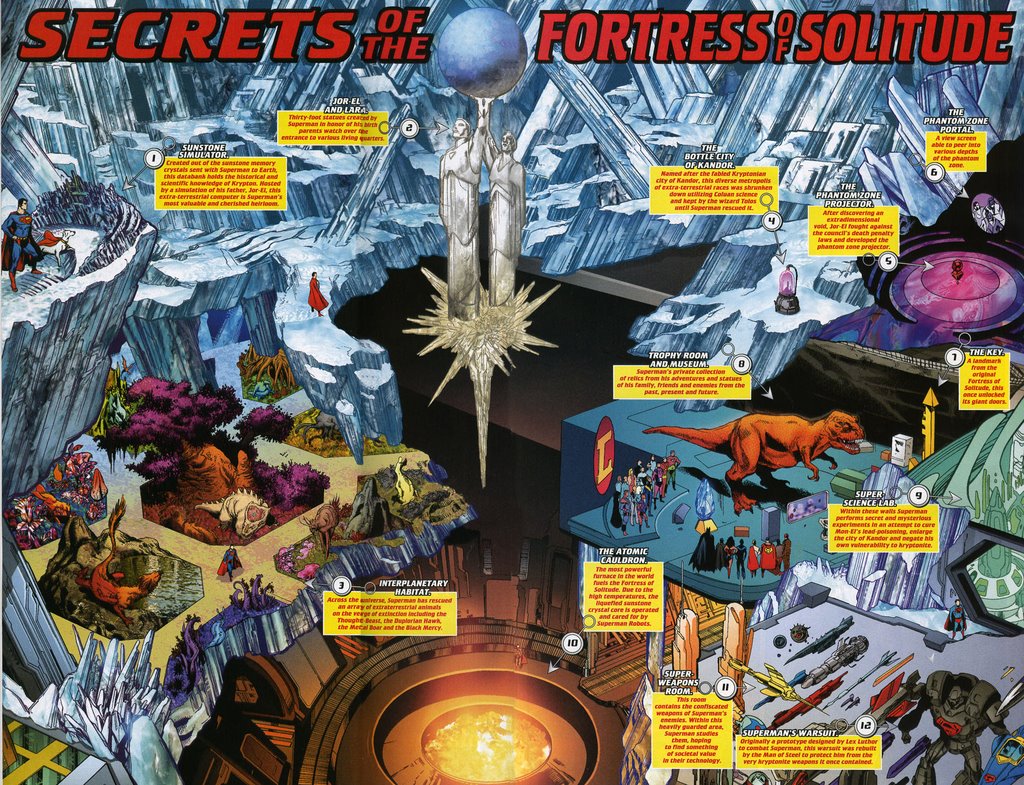
Okay, now that is the closest they've come to this since John Byrne dismantled the franchise after Crisis on Infinite Earths. Added in, though, are nice little grace notes that call back to the version more familiar to viewers of the film series (including the most recent installment), or to Smallville sufferers, for that matter (and speaking as one who suffered through the crap-fest that show has become far longer than I should have, only giving up in the middle of the current season, I know whereof I speak).
The stories on either side of that spread are not half bad, either. We get the reintroduction of Mon-El, Superboy's "older brother," in a tone that fits the current continuity but hews as close as possible to the original Silver Age version (and ties into the reappearance of the character in Mark Waid's Supergirl and the Legion of Super-Heroes), we get the aforementioned "secret origin" of Non, Zod, and Ursa, and a few short pieces about Superman's rogues gallery, including bookends of Lex Luthor thinking about killing Superman, and thinking about Kryptonite, in all its many hues.
Clearly, the Superman titles have faired better than most in the "One Year Later" aftermath of Infinite Crisis. Arguably, the line has never been better, and between Busiek on Superman, Johns and Donner on Action, and Morrison on All Star Superman, it's actually difficult to imagine how it could be much better. Most of the rest of DC's current superhero output has left me decidedly cold, and I've dropped almost every title I was buying, both those I picked after the OYL stunt, and those I was buying back before the Infinite Crisis debacle even got rolling. If just this one little corner of the DC Universe can maintain this level of quality for a while, though, then maybe it was worth it, at least for me. And if we keep getting little infusions of the Silver Age as can be found in this annual, then I'll keep coming back.
Doomsday Vault, Revisited
Hey, remember this? The Norwegian "doomsday vault" of seeds (well guarded by polar bears!), positioned safely away from civilization in Santa Claus country? Well, it appears that Norway has gone and revealed the design.

I'm of two minds about this. It's eitehr a perfect secret headquarters for a James Bond villain with a cold-weather theme (Doctor Frost, or some such), or it should have a big gold arrow pointing at it.
My question is, where do they keep the polar bears?

I'm of two minds about this. It's eitehr a perfect secret headquarters for a James Bond villain with a cold-weather theme (Doctor Frost, or some such), or it should have a big gold arrow pointing at it.
My question is, where do they keep the polar bears?
Underground Ocean
Cheryl Morgan just sent me this little gem, for which I owe her.
The question is, will the first to explore this underground sea find the initials of Arne Saknussemm already carved on the shore, waiting for them...
A seismologist at Washington University in St. Louis has made the first 3-D model of seismic wave damping — diminishing — deep in the Earth's mantle and has revealed the existence of an underground water reservoir at least the volume of the Arctic Ocean. It is the first evidence for water existing in the Earth's deep mantle.How cool is that?
The question is, will the first to explore this underground sea find the initials of Arne Saknussemm already carved on the shore, waiting for them...
Burning Safari
(via) You need to watch "Burning Safari". It's amusing little short with robots and monkeys (and not only that, but robots versus monkeys). What more could you want?
Wednesday, February 07, 2007
Jess Nevins's Pulp Magazine Holdings Directory
Warren Ellis has excellent taste, and I'm happy to second his suggestion. The inestimable Jess Nevins has a new reference work forthcoming from MacFarland, Pulp Magazine Holdings Directory, and while the book isn't out just yet, it appears the publisher is accepting preorders. Come on, you know you want it...


The Day's Progress - Wednesday Edition
A good day today, as I managed to get an early start, and steamed on ahead until I hit the end of "Twilight." I had to leave the last section unfinished, since the action overlaps with "Millennium," the last act, and since I want them to flow together smoothly I'll have to write them at the same time. But aside from a few hundred words to be done at a later date, the first of three acts is done. Three days later than expected, but close to 20K words longer. Whoops! It'll all come out in the wash, though, I'm sure, with the other two sections (hopefully) coming out only a bit longer than originally planned, so that I won't end up too much over my wordcount. (I hope!)
I'm taking tomorrow and Friday to take care of some much needed administrivia, mailing contracts and the like, and outlining a couple of new scenes for the expanded Set the Seas on Fire. Then, having shifted gears over the weekend, I'll start in on "Jubilee" on Monday. Switching from 498AD to 1897AD, from the last days of High King Artor to the Diamond Jubilee of Queen Victoria, shouldn't prove too jarring a transition, right?
| |
53,056 / 120,000 (44.2%) |
The trio found themselves in a labyrinth of narrow, winding passages. At first, Galaad found them a pleasant change from the monotonous engulfing spaces of the corridors beyond, but when they had taken a dozen turns or more, each time finding themselves facing another turn and wall, the novelty quickly wore off.
After stalking through the winding labyrinth for what seemed an eternity, they took a final turn and found themselves at the threshold of a massive chamber. The ceiling was so high as to be invisible from the floor, while the walls receded so far in ever direction that they were only just visible. Galaad, who’d long since ceased trying to work out how so much space could be contained within the confining walls of the tower of glass, reeled at the sight of it.
But the space was not empty. The floor of the enormous chamber was dominated by what appeared to be some sort of gwyddbwyll board, the floor demarked in an immense checkered grid, on which stood pieces of silver or glass, each as tall as a house. The pieces, to Galaad’s astonishment, seemed to move of their own accord, sliding back and forth across the floor.
So stunned was Galaad by the gwyddbwyll set that he momentarily failed to notice the two gargantuan figures hulked on either side. They were of such a scale, of such monstrous proportions, that it seemed as if they would not at first fit inside his mind, dominating so much of the view on either side of the board that they essentially disappeared from view. But in short order he came to realize that it wasn’t that one side of the room had a red hue and the other side white, but that there crouched on either side of the massive board two monstrously large figures, one red and one white.
They were dragons. Or not dragons, precisely, but that was the only word in Galaad’s vocabulary that came close to encompassing them. They were enormous, immense, unimaginably large. Somewhere high above on either side was something suggesting a head, or even a face, regarding the movement on the board between them, while the movements of Artor, Pryder, and Galaad were completely beneath their notice.
Pryder was for attacking the dragons, but Artor was quick to stay his hand. It would do no good, the High King insisted, having no more effect than a gnat attacking a mountain. Whatever these immense dragons were, it was beyond their ken, and on a scope far in excess of anything that mere men could affect. Better to continue on, and seek the Red King or the White Lady elsewhere.
It took them some considerable time to skirt around the immense beings, but finally they came to another archway, opposite that through which they’d exited the labyrinth, which lead into still more twisting corridors. At Artor’s insistence they quitted the giant chamber, leaving the dragons to contemplate their game, and their search continued.
Sunstone
News of a study that suggests that Vikings may have used crystals to aid in sea navigation on cloudy days. The crystals, called "sunstones", would have allowed them to polarize whatever daylight was available to determine the position of the sun.
"Polarisation cannot be seen with the naked eye, but it can be viewed with what are known as birefringent crystals, or sunstones.There's something about crystal-gazing Vikings that I find very appealing....
Birefringence, or double refraction, is the splitting of a light wave into two different components - an ordinary and an extraordinary ray.
The researchers found that the crystals could be used to find out where the sun was in the sky in certain foggy or cloudy conditions."
Tuesday, February 06, 2007
The Day's Progress - Tuesday Edition
I got up a pretty good head of steam today, which was nice. Looking back over previous projects, I seem to follow a similar pattern, picking up speed as the week goes on, then starting back at a somewhat slower pace the following week. Last week was all skewed since I lost all of Wednesday and part of Thursday and Friday to Georgia and Allison's stomach flus, which meant I was never able to get up to speed. With any luck, I'll be able to finish "Twilight" sometime tomorrow, longer and later than anticipated, but not disastrously so.
Lots of stuff packed into today's writing. The first encounter with the Red King. The first glimpse (in person, at least) of the Tower of Glass. And the little bit of business where Artor names his new sword, Hardspace.
Today's sample comes from the early part of the day's writing. It is what it says...
| |
46,458 / 120,000 (38.7%) |
Lots of stuff packed into today's writing. The first encounter with the Red King. The first glimpse (in person, at least) of the Tower of Glass. And the little bit of business where Artor names his new sword, Hardspace.
Today's sample comes from the early part of the day's writing. It is what it says...
They had walked for some time when the first caught sight of the rider, and first heard the white hounds coursing in his wake, their baying like wild geese in flight.
The rider approached at speed, coming out them out of the indistinct blue haze of the middle distance. He was astride some sort of beast, the size of a horse but with the look of a lizard, its scales red, with a long ropy tail and fierce talons. Tendrils trailed like whiskers from the sides of its massive head, and in its fierce mouth were four large teeth, two above and two below, its eyes burning as if lit by flames from within.
“The Huntsman!” Galaad shouted, seeing the thin red blade the rider held aloft.
But as the rider thundered nearer, Galaad saw that he’d been wrong. This was not the same strange figure they’d faced in Llongborth, though it bore the same red sword and was followed by the spectral dogs of wrath. This rider was larger than the Huntsman had been, and while the Huntsman had been hairless the rider’s face was covered by a full red beard, his long red hair streaming behind him as he rode. And while the Huntsman’s face had been frozen and immobile, the rider’s face was clearly expressive, mouth open in a defiant snarl. Only the skin of his cheeks and forehead could be seen, and this little corpse-white, while the rest of his body was entirely encased in some sort of close-fitting red armor, than shone dully like metal but bent freely without joint or hinge.
Whoever the rider was, though, it was clear he meant harm to the seven.
As the rider drew nearer, Galaad remembered the White Lady’s warning—beware the Red King.
Monday, February 05, 2007
Visitor Map
Because yes, I would jump off a bridge if someone else did first, provided it looked like fun...

Create your own visitor map!
If this works, the map will slowly fill with little white diamonds (I hear Elizabeth Taylor, filmed through muslin, repeating those words, "White Diamonds...") as folks visit my site. Of course, I only read rss feeds through bloglines, so maybe this isn't the best test, after all...
Create your own visitor map!
If this works, the map will slowly fill with little white diamonds (I hear Elizabeth Taylor, filmed through muslin, repeating those words, "White Diamonds...") as folks visit my site. Of course, I only read rss feeds through bloglines, so maybe this isn't the best test, after all...
The Day's Progress - Monday Edition
I moved the goal posts today. It's become increasingly clear that this book is going to be a mite longer than the 100K I'd originally thought, and much longer than the 90K I at least hoped I'd make. Elizabeth Bear said something typically insightful yesterday, talking about her own work-in-progress.
Today's sample comes a bit after Artor and his men have met the White Phantom, who gave them all sorts of useful weapons and such, in time-honored fashion. They've marched a bit further into the Summer Lands, and decided to make camp near a stream.
I have switched over from "I'm never going to invent enough plot to fill up this book" to "How the heck am I supposed to cram what's left into 157 pages?"The specific page numbers aside, that's me to a T. I always start a project convinced I'll never be able to find enough stuff to fill a book, and invariably find myself at some point wondering how I'm ever going to make everything fit. Even though I'm only on the first of three acts, I'm already at that point, since this first act has run so much longer than anticipated. Yeesh. So, after a quick confab with my editor, I've moved the wordlength out from 100K to 120K. It may end up even a bit longer than that, but that's my goal.
| |
40,771 / 120,000 (34.0%) |
Today's sample comes a bit after Artor and his men have met the White Phantom, who gave them all sorts of useful weapons and such, in time-honored fashion. They've marched a bit further into the Summer Lands, and decided to make camp near a stream.
“Look!” Bedwyr shouted, and pointed across the stream.
The others followed his gaze, and there on the far side of the stream they saw a group of people standing. At this distance, it was difficult to make out any details, too much obscured in the diffuse twilight, but Galaad could see that they were men, and not giant monsters like those they had faced on the shore.
The captains laid their hands on their weapons, warily, and hurried to the stream’s edge.
“Halloo,” Artor called, cupping his hands around his mouth like a trumpet. “Are you friend or foe?”
There were seven of the strangers, Galaad now saw, all facing away from the stream, their backs to Artor and his men. One glanced over his shoulder at them, but did not speak. Then he looked away, and the seven strangers waded backwards into the stream.
“What madness...?” Caius began.
When the last of the strangers had backed into the stream, a kind of haze appeared before Galaad’s eyes, and when it cleared the strangers had disappeared from view.
Artor ordered the captains to keep careful watch on the stream, in case the strangers had submerged and swum to their side, but the waters of the stream remained undisturbed, and there was no further sign of the strangers.
Sunday, February 04, 2007
Lost on an island
(via) The folks at College Humor ask the music question, what if Lost had a proper theme song, like TV shows used to have?
The answer:
(If the embedded video doesn't load, just head here.)
The answer:
(If the embedded video doesn't load, just head here.)
Friday, February 02, 2007
Whedon off Wonder Woman
Well, crap. I was actually looking forward to a superhero flick, for once. Whedon's announcement is here, but here's the most relevant bit:
"You (hopefully) heard it here first: I'm no longer slated to make Wonder Woman. What? But how? My chest... so tight! Okay, stay calm and I'll explain as best I can. It's pretty complicated, so bear with me. I had a take on the film that, well, nobody liked. Hey, not that complicated.I think the odds for a watchable Wonder Woman flick just got a lot longer, I'm afraid.
Let me stress first that everybody at the studio and Silver Pictures were cool and professional. We just saw different movies, and at the price range this kind of movie hangs in, that's never gonna work. Non-sympatico. It happens all the time. I don't think any of us expected it to this time, but it did. Everybody knows how long I was taking, what a struggle that script was, and though I felt good about what I was coming up with, it was never gonna be a simple slam-dunk. I like to think it rolled around the rim a little bit, but others may have differing views."
The Day's Progress - Friday Edition
Well, whatever stomach bug Georgia had the other day, Allison has now, so I'm doing solo parenting. Got a few good hours of work in between taking Georgia to preschool and heading off to pick her up, so managed to beat the day's quota, but not by much.
Today's writing included a pivotal scene, as Artor, Galaad, and the others enter the "hedge of mist" that Geraint has told them about, and find themselves in the Summer Lands. Then, of course, they stop for lunch, because, really, who wouldn't?
After lunch, they start doing a bit of exploring, and encounter some of the natives, which brings us to today's sample.
| |
35,891 / 100,000 (35.9%) |
Today's writing included a pivotal scene, as Artor, Galaad, and the others enter the "hedge of mist" that Geraint has told them about, and find themselves in the Summer Lands. Then, of course, they stop for lunch, because, really, who wouldn't?
After lunch, they start doing a bit of exploring, and encounter some of the natives, which brings us to today's sample.
The seven had so far encountered no living thing in the Summer Lands, save the unearthly silver-branched glass-apple trees, but after a time they came upon a herd of strange creatures, the likes of which none of them had ever seen.
There were some dozen of the beasts in all. They seemed an unlikely mixture of badger and lizard, with white fur over their round bellies and fierce-looking talons on the tips of their narrow feet, their protruding snouts ending in a long, spiraling horn. These horned beasts munched contentedly on a pasture of the bright-red heath, and paid the seven no mind.
A short while later, they encountered a flock of birds that stood on tall, thin legs, their snow-white feathers sticking out in all directions, that regarded them with cool, emotionless gazes. As the seven drew near, the ungainly birds opened their enormous beaks, emitting ear-piercing shrieks, and then ran away, feathers ruffling, their long legs carrying them in prodigious strides across a hillside and out of sight.
If there had remained any doubts that they now walked in decidedly unearthly lands, such had long been dispelled. The seven had managed to become somewhat accustomed to whatever element of the environment had unmanned them beneath the silver trees, but they were still queasy, even slightly disoriented. Fortunately for them, the worst effects of the condition seemed to ebb and flow like waves, such that while any one of them was suffering the worst of it, another was in a better state, and so together they were able to advance across the Summer Lands without overmuch delay.
They hoped aloud that these difficulties would wane and pass as they spent more time in this climate, but as yet there were no signs of any general improvement. As it was, they counted themselves lucky that none of the fauna they had encounter had yet proved hostile to them.
Then they reached the shore, and fortune, it seemed, was no longer with them.
Sword-Wielding Robot
That's right, I said, sword-wielding robot.
Just keep watching past the tennis swings, and you get to the good stuff...
Just keep watching past the tennis swings, and you get to the good stuff...
Thursday, February 01, 2007
Second Use
But is it "second use" if the first never came about?
Jonathan Strahan blogs about how a confluencs of events lead to the illustration that Stephan Martiniere did a few years back for a never-published edition of The Voyage of Night Shining White ending up on the cover of the forthcoming Book Club anthology, Best Short Novels: 2007. I've had a print of that piece hanging on my wall for years, and I'm glad to see it's finally gone to a good home.
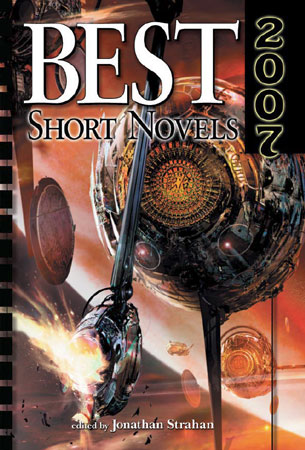
Jonathan Strahan blogs about how a confluencs of events lead to the illustration that Stephan Martiniere did a few years back for a never-published edition of The Voyage of Night Shining White ending up on the cover of the forthcoming Book Club anthology, Best Short Novels: 2007. I've had a print of that piece hanging on my wall for years, and I'm glad to see it's finally gone to a good home.
The League of Extraordinary Gentlemen (Vol III): Century
Oh, yes. That's right, I said The League of Extraordinary Gentlemen (Vol III): Century. I was just alerted to the solicitation on publisher Top Shelf's website (scroll down just past the listing for From Hell).

So what's it about? Well, let's see, shall we?
(And if that weren't enough, and I can't imagine it is, scroll a bit further down the page to see the listing for The Moon and Serpent Bumper Book of Magic, coming in 2009!)

So what's it about? Well, let's see, shall we?
The third volume detailing the exploits of Miss Wilhelmina Murray and her extraordinary colleagues is a 216-page epic spanning almost a hundred years and entitled Century. Divided into three 72-page chapters, each a self-contained narrative to avoid frustrating cliff-hanger delays between episodes, this monumental tale takes place in three distinct eras, building to an apocalyptic conclusion occurring in our own current twenty-first century.Okay, I'm sold. Now, is it 2008 yet?!
Chapter one is set against a backdrop of London, 1910, twelve years after the failed Martian invasion and nine years since England put a man upon the moon. With Halley's Comet passing overhead, the nation prepares for the coronation of King George V, and far away on his South Atlantic Island, the science-pirate Captain Nemo is dying. In the bowels of the British Museum, Carnacki the ghost-finder is plagued by visions of a shadowy occult order who are attempting to create something called a Moonchild, while on London's dockside the most notorious serial murderer of the previous century has returned to carry on his grisly trade. Working for Mycroft Holmes' British Intelligence alongside a rejuvenated Allan Quartermain, the reformed thief Anthony Raffles and the eternal warrior Orlando, Miss Murray is drawn into a brutal opera acted out upon the waterfront by players that include the furiously angry Pirate Jenny and the charismatic butcher known as Mac the Knife.
Chapter two takes place almost sixty years later in the psychedelic daze of Swinging London during 1968, a place where Tadukic Acid Diethylamide 26 is the drug of choice, and where different underworlds are starting to overlap dangerously to an accompaniment of sit-ins and sitars. The vicious gangster bosses of London's East End find themselves brought into contact with a counter-culture underground of mystical and medicated flower-children, or amoral pop-stars on the edge of psychological disintegration and developing a taste for Satanism. Alerted to a threat concerning the same magic order that she and her colleagues were investigating during 1910, a thoroughly modern Mina Murray and her dwindling league of comrades attempt to navigate the perilous rapids of London's hippy and criminal subculture, as well as the twilight world of its occultists. Starting to buckle from the pressures of the twentieth century and the weight of their own endless lives, Mina and her companions must nevertheless prevent the making of a Moonchild that might well turn out to be the antichrist.
In chapter three, the narrative draws to its cataclysmic close in London 2008. The magical child whose ominous coming has been foretold for the past hundred years has now been born and has grown up to claim his dreadful heritage. His promised aeon of unending terror can commence, the world can now be ended starting with North London, and there is no League, extraordinary or otherwise, that now stands in his way. The bitter, intractable war of attrition in Q'umar crawls bloodily to its fifth year, away in Kashmir a Sikh terrorist with a now-nuclear-armed submarine wages a holy war against Islam that might push the whole world into atomic holocaust, and in a London mental institution there's a patient who insists that she has all the answers.
Drawing from the fiction, theatre, film and television culture of the twentieth century as artfully as the preceding volumes drew upon the literature of the nineteenth, this first installment of the League's adventures to be co-published by Top Shelf Productions and Knockabout takes our familiar cast of characters … plus several previously unfamiliar … and propels them into a new age, a new world every bit as strange and savage as the colourful Victorian era they were born to. More than this, with its third volume the League's exploits move into a different realm of format, artistry and story-telling as this remarkable series sets out to explore the full limits of the vast fictional cosmos that it has marked as its territory. A unified field theory of fiction as much as a comic-book story, The League of Extraordinary Gentlemen (Volume III): Century is sure to be like nothing you have ever read, and will be co-published in three lavish, full-color individual volumes by Top Shelf Productions and Knockabout, commencing in 2008.
Published as three deluxe, 72-page, full-color, perfect-bound graphic novellas, written by Alan Moore and illustrated by Kevin O'Neill.
SHIPPING IN 2008!
ISBN 978-1-60309-000-1
(And if that weren't enough, and I can't imagine it is, scroll a bit further down the page to see the listing for The Moon and Serpent Bumper Book of Magic, coming in 2009!)
The Day's Progress - Thursday Edition
There are days when the words just seem to flow. I'll sit down and start typing, and before I know it I've just effortlessly written a couple of thousand words, all of it useable.
And then there are days like today.
I got a late start this morning, and then lost another hour futzing with my webhosting company on the phone, so had only written a few hundred words before lunch. The afternoon was no better. Everytime I paused to take a break, and checked my progress, I found that I'd written considerably fewer words than I'd thought. I managed to make my daily quota, but only by continuing to bash my head against the scenes until they surrendered and lay down on the page like they're supposed to do.
No sample today, as I don't have time to go back and pick out a suitable bit. I'll just give you the last line I wrote today, which out of context won't make much sense, I'm afraid.
And then there are days like today.
I got a late start this morning, and then lost another hour futzing with my webhosting company on the phone, so had only written a few hundred words before lunch. The afternoon was no better. Everytime I paused to take a break, and checked my progress, I found that I'd written considerably fewer words than I'd thought. I managed to make my daily quota, but only by continuing to bash my head against the scenes until they surrendered and lay down on the page like they're supposed to do.
| |
31,650 / 100,000 (31.6%) |
No sample today, as I don't have time to go back and pick out a suitable bit. I'll just give you the last line I wrote today, which out of context won't make much sense, I'm afraid.
“Go, damn your hide!” Galaad yelled, kicking his heels, and as the horse thudded across the frozen ground, the dragon above his head ate the wind, its tail coursing behind.
Cult Fiction
John Seavey has posted some interesting thoughts on what he calls "cult fiction," by which me means all the sorts of stuff that geeks like us like.
Ultimately, I think the only thing they have in common is that they all present the world, in some way, as stranger than real life. This is most overt in science-fiction, which is why I think that it all tends to get lumped in as sci-fi, but even the non-science-fiction series like '24' or 'Alias' show a world which is bigger, more dangerous, more exciting, and more vivid than the one we live in every day. (And sketch comedy shows, almost by definition, explore a "stranger than life" idea to its logical conclusion--like the Lumberjack sketch, for example.) I think this is what we're attracted to, the idea that we live in a super-interesting universe, and that these are looks around the corner to the bits that we don't usually see. Bits where kids can build a working space shuttle out of stuff they send away from on cereal boxes, bits where hidden wizard academies teach the sorcerers of tomorrow; bits, in short, that we can always imagine ourselves just about to stumble into.I started reading Seavey's blog a few weeks back, having followed a link to one of his colums on various comic series as "storytelling engines." Some very insightful stuff along the way.
Locus Magazine's Recommended Reading: 2006
Locus Magazine has released their list of Recommended Reading for 2006, in case you hadn't heard. Lots of books by people I like and admire on here, which is always good to see. And what's this? Why, the list seems to include a few even more familiar names and titles, as well...
Things I published:
The Man from the Diogenes Club, Kim Newman
Myths for the Modern Age, Win Scott Eckert, ed.
Blood and Thunder, Mark Finn
Cover Story, John Picacio
and Neal Barrett Jr.'s "The Heart" from Cross Plains Universe
Anthologies in which I appear:
Futureshocks, Lou Anders, ed.
Forbidden Planets, Peter Crowther, ed.
The Year's Best Science Fiction: Twenty-third Annual Collection, Gardner Dozois, ed.
And things I wrote my ownself:
The Voyage of Night Shining White, Chris Roberson
How about them apples?
It looks like the February issue of Locus, in which this list will run, also contains reviews of Night Shining White, and of Pete Coogan's Superhero, for what it's worth.
Things I published:
The Man from the Diogenes Club, Kim Newman
Myths for the Modern Age, Win Scott Eckert, ed.
Blood and Thunder, Mark Finn
Cover Story, John Picacio
and Neal Barrett Jr.'s "The Heart" from Cross Plains Universe
Anthologies in which I appear:
Futureshocks, Lou Anders, ed.
Forbidden Planets, Peter Crowther, ed.
The Year's Best Science Fiction: Twenty-third Annual Collection, Gardner Dozois, ed.
And things I wrote my ownself:
The Voyage of Night Shining White, Chris Roberson
How about them apples?
It looks like the February issue of Locus, in which this list will run, also contains reviews of Night Shining White, and of Pete Coogan's Superhero, for what it's worth.


